Adding Renewable Energy to Buildings: The Upgrade That Changes Everything
The buildings that win the next decade will not just use energy. They will generate, store, and manage it with intent.
For years, adding renewable energy to a building was treated like a sustainability extra: admirable, visible, and easy to postpone. That framing no longer works. Buildings account for about 30% of global energy demand, and electricity is taking a larger share of how buildings operate as heating, cooling, appliances, controls, and mobility all move toward electrification. In other words, the building is no longer just a shell for energy use. It is becoming part of the energy system itself.
That shift matters to every engineering discipline. Structural teams are being asked to think about roof loading and façade integration. Electrical engineers are dealing with inverters, storage, interconnection, and EV charging. Mechanical engineers are coordinating renewable electricity with heat pumps and ventilation strategies. Controls engineers are turning buildings into responsive assets. And owners are no longer asking only, “What will it cost?” They are also asking, “What happens if we do nothing?” In the UK, rooftop solar is now being positioned as a key route to lower bills, especially when paired with self-consumption, storage, and export through the Smart Export Guarantee.
Why is this no longer a niche decision
The engineering case starts with a blunt reality: buildings are hungry. In advanced economies, most energy used in homes still goes into space heating and hot water, and globally the sector’s energy demand remains enormous. That means the opportunity is equally enormous. A building that reduces demand and adds well-integrated renewable systems does not just cut emissions; it changes operating economics, resilience, and long-term asset quality.
This is why renewable energy on buildings has moved beyond image and into asset strategy. Solar PV, batteries, smart controls, and electrified heating are no longer separate conversations. They are parts of the same design problem: how to reduce imported energy, smooth peak demand, and make the building more valuable and less exposed to volatile energy prices. The smartest projects do not treat renewables as bolt-ons. They treat them as core infrastructure.
What “adding renewables” actually means.
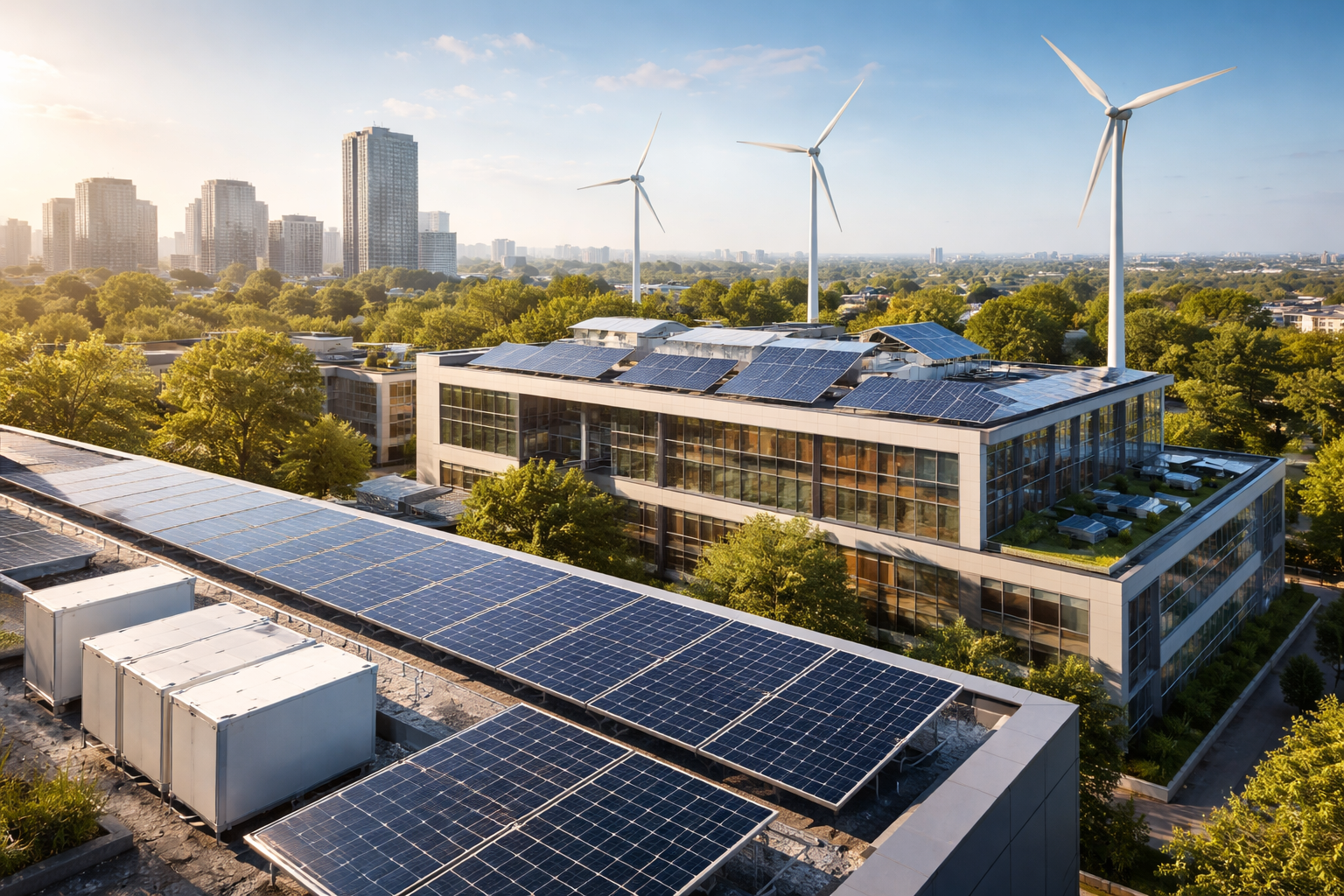
For most buildings, the first move is still rooftop solar PV. It is mature, modular, and relatively easy to model. But the menu is getting broader. Photovoltaics can now be integrated into roofs, façades, awnings, pergolas, windows, skylights, and balustrades. In those cases, the solar element is not just producing electricity; it is also doing building-envelope work such as weather protection, shading, or material replacement. That is where renewable integration begins to become true engineering rather than equipment procurement.
There is a useful distinction here. Conventional rooftop PV is often the most straightforward route for retrofit. Building-integrated photovoltaics, or BIPV, become more compelling when a project already involves reroofing, recladding, or a new-build envelope strategy. BIPV can offset some conventional construction costs by replacing another material, but it has also faced higher upfront costs and lower market uptake than standard rooftop PV. The lesson is not that BIPV is overhyped. It is that the design and procurement pathway matters just as much as the technology itself.
Storage and controls are the other half of the story. A building with solar but no intelligence still leaves value on the table. Once batteries, smart inverters, sensors, and control logic are added, the building can decide when to consume, store, export, and reduce peak demand. This is the point at which a renewable installation stops being a hardware upgrade and becomes an operating strategy.
Heat pumps deserve a place in this conversation, too, even though they are not a renewable generator in themselves. They are often the missing link that lets a building make better use of renewable electricity. Electrification and renewable integration reinforce each other: as buildings shift heating loads onto efficient electric systems, renewable power becomes more useful across more hours of the year.
The engineering rule that matters most: cut load before chasing generation
This is where many projects either become elegant or expensive. The cheapest kilowatt-hour is still the one the building never needed. If the envelope leaks, solar gains are unmanaged, ventilation is poorly controlled, or heating loads are unnecessarily high, renewable systems end up compensating for avoidable waste. That is bad engineering and bad economics.
The better sequence is clear: reduce demand first, then electrify wisely, then add generation, then add flexibility. In practical terms, that means improving insulation, airtightness, glazing performance, ventilation strategy, and control quality before sizing renewable systems. The logic repeatedly shows up in high-performing projects. Powerhouse Brattørkaia, for example, combines very low energy demand with heat recovery, intelligent airflow, and seawater-based heating and cooling before leaning on its renewable generation to go further.
Flexibility is the next layer. Grid-interactive efficient buildings combine efficiency, renewable integration, and demand flexibility to lower energy costs while improving reliability and resilience. When buildings can shift or trim demand during peak periods, they do more than save the owner money. They also become easier to operate in a grid with higher shares of variable renewable generation. That is a major engineering opportunity hiding inside what looks, on the surface, like a utility bill problem.
The business case is broader than the utility bill.
The visible barrier is still the capital cost. In the UK, a domestic solar system for a typical three-bedroom home has been cited at roughly £5,000 to £9,000, with battery storage often adding £3,000 to £7,000. Typical annual savings for a home with solar and a battery have been estimated at around £600 to £1,000, while export schemes such as the Smart Export Guarantee add another revenue stream for surplus electricity. That does not make every project instantly cash-rich, but it does mean the economics are no longer fringe.
The more interesting story is what happens beyond the meter. UK research linked to Swansea University found that homes with solar panels can command a sale price premium of roughly 6.1% to 7.1%. Rightmove has reported that moving a home from EPC F to EPC C can raise value by about 15%. Legal & General research has also found that buyers are willing to pay a premium for low-carbon homes, with especially strong interest among younger buyers. That means renewable upgrades increasingly influence not only operating costs but also liquidity, marketability, rental performance, and perceived quality.
For commercial buildings, the same logic becomes sharper. Energy strategy is now tied to tenant expectations, ESG targets, compliance risk, and long-term obsolescence. A building that cannot support electrified heating, smart controls, solar integration, and flexible load management may still function, but it becomes harder to defend as a premium asset. Renewable integration is increasingly about protecting value, not just demonstrating values.
What good integration looks like in practice
Good projects begin with an audit, not an equipment brochure. Engineers need to understand load profiles, roof condition, structural capacity, shading, inverter location, cable routes, fire strategy, maintenance access, and the building’s likely future electrification loads. A solar array sized for today’s demand may be undersized once EV charging or a heat pump is added. A battery selected only for backup may underperform financially if tariff optimization and demand management were not considered. The design problem is always bigger than the panels can handle.
Retrofit and new build also deserve different playbooks. In retrofit, conventional PV often wins because it is lower risk, simpler to install, and easier to finance. In reroofing or major façade renewal, BIPV starts to make more sense because the renewable system can replace part of the envelope cost. That same logic helped justify the CIS Tower scheme in Manchester, where photovoltaic cladding was integrated into the refurbishment rather than treated as a decorative afterthought.
Real-world examples that show the range
The Bullitt Center in Seattle remains one of the clearest demonstrations of what disciplined integration can achieve. The six-story, 52,000-square-foot office building generates as much energy from rooftop photovoltaics each year as it uses. It is a reminder that high-performance buildings do not have to choose between commercial usefulness and radical energy ambition.
Powerhouse Brattørkaia in Trondheim pushes the concept even further. It is described as the world’s northernmost energy-positive building, producing more than twice as much electricity as it consumes daily. It combines extreme efficiency, heat recovery, intelligent airflow, and seawater-based thermal systems with renewable generation and a local microgrid that can also serve neighboring uses. The point is not that every office should copy it exactly. The point is that climate and latitude are not excuses for timid design.
The Edge in Amsterdam shows what happens when renewable generation meets data-rich building operation. Its solar installations extend across façades, roofs, and remote rooftops, and its Ethernet-powered LED system is tied to 30,000 sensors that continuously adjust building energy use. This is the model of a building as a responsive platform, not a static consumer.
Then there is the CIS Tower in Manchester, which remains a useful lesson in retrofit. The project turned the tower into what was described as the largest commercial solar façade in Europe at the time, using 7,244 photovoltaic cells integrated into a weatherproof recladding system. It is an excellent example of how renewables can be folded into necessary capital works, rather than added only when a project has “green budget” left over.
Where projects go wrong
Most failures are not technology failures. They are integration failures. Teams oversize solar on inefficient buildings. They underestimate electrical upgrades. They ignore load timing and end up exporting low-value power while importing expensive evening electricity. They add batteries without a control strategy, or they specify elegant façades without thinking through maintenance and access. Sometimes the system works exactly as designed; the problem is that it was designed too narrowly.
There is also a recurring cultural problem in project teams: renewable energy is often delegated to one specialist too late in the process. But adding renewables to buildings is not a single-discipline task. It is a coordination exercise across architecture, structure, MEP, controls, cost planning, planning compliance, and facilities management. The projects that succeed are usually the ones that make this a design conversation early, not a late-stage add-on.
The bigger shift
The most important thing to understand is that renewable energy does not simply make buildings cleaner. It changes what a building is. A building with on-site generation, electrified systems, storage, and smart controls is no longer just a shelter connected to a utility. It becomes an active energy asset: one that can shave peaks, ride through volatility, support electrification, and hold value better in a carbon-constrained market.
That is why adding renewable energy to buildings is becoming less about virtue and more about competence. The question is no longer whether buildings should participate in the energy transition. They already are. The real question is whether engineers, owners, and developers will treat that transition as a cosmetic upgrade or as the beginning of a much better kind of building.