
Course Overview
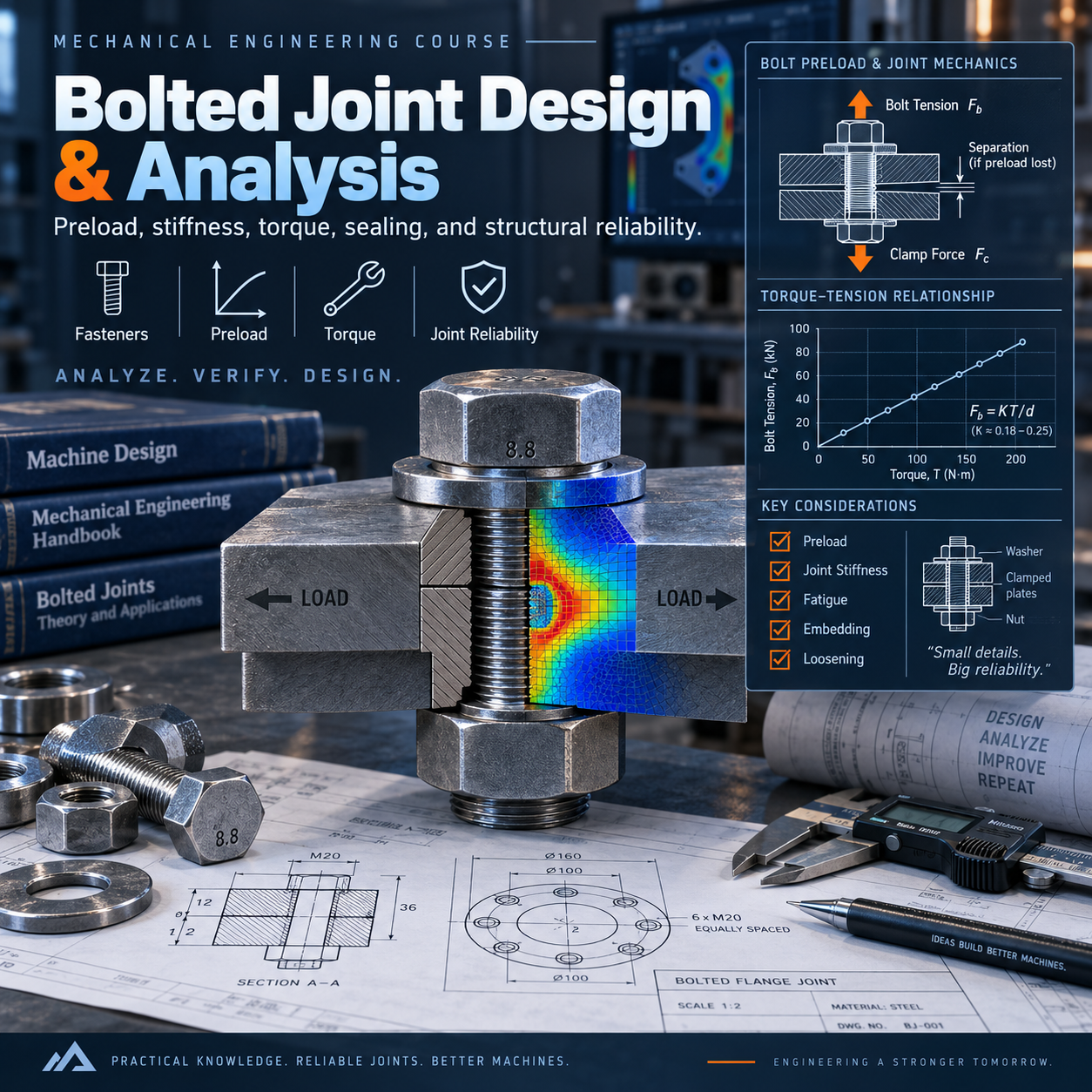
Bolted Joint Design & Analysis
Design bolted joints that maintain clamp load, resist separation, and survive real service loading.
Understand preload, stiffness, load sharing, fatigue, separation, slip, torque control, and failure modes in bolted mechanical joints.
Why This Course Matters
Bolted joints often fail because the interaction between preload, joint stiffness, external loading, friction, fatigue, and tightening method is misunderstood. A bolt can be correctly sized for simple tensile load and still loosen, slip, separate, or fail prematurely in service.
Modern mechanical design depends on the ability to translate requirements into geometry, calculations, simulation evidence, manufacturing definition, and verification. The strongest engineers understand both the analytical method and the practical consequences of the design choices they make.
This course is designed to close that capability gap with structured, engineering-focused learning that strengthens both technical understanding and professional judgement.
What This Training Helps You Achieve
Understand preload, stiffness, load sharing, fatigue, separation, slip, torque control, and failure modes in bolted mechanical joints. The training is designed to help you apply this knowledge with greater confidence across design, analysis, verification, manufacturing, and engineering review, while making assumptions, limitations, and technical reasoning easier to explain and defend.
Why Engineers Take This Course
Control preload and load sharing
Develop stronger capability in bolt and joint mechanics, load paths, and stiffness relationships, and use that understanding to support more credible decisions in design, analysis, verification, manufacturing, and engineering review.
Prevent separation, slip, and fatigue failure
Develop stronger capability in joint separation, slip, bearing, and thread failure modes, and use that understanding to support more credible decisions in design, analysis, verification, manufacturing, and engineering review.
Specify and assess bolted joints more rigorously
Develop stronger capability in practical verification, tightening methods, inspection, and failure investigation, and use that understanding to support more credible decisions in design, analysis, verification, manufacturing, and engineering review.
What You’ll Explore
- Bolt and joint mechanics, load paths, and stiffness relationships
- Preload, proof load, tightening targets, and preload scatter
- Torque-tension relationships and the influence of friction
- External tensile and shear loading of preloaded joints
- Joint separation, slip, bearing, and thread failure modes
- Fatigue behaviour of bolts and the importance of preload retention
- Thread geometry, engaged length, and load distribution
- Gaskets, thermal effects, relaxation, embedding, and loss of clamp load
- Practical verification, tightening methods, inspection, and failure investigation
Learning Outcomes
By the end of this course, you will be able to:
- Explain and apply the core principles associated with bolt and joint mechanics, load paths, and stiffness relationships.
- Interpret engineering information related to preload, proof load, tightening targets, and preload scatter.
- Evaluate practical considerations involving torque-tension relationships and the influence of friction.
- Recognise key assumptions, limitations, and risks associated with joint separation, slip, bearing, and thread failure modes.
- Use structured engineering judgement when working with gaskets, thermal effects, relaxation, embedding, and loss of clamp load.
- Connect analysis and technical evidence with practical verification, tightening methods, inspection, and failure investigation.
- Approach bolted joint design & analysis work with greater technical confidence, discipline, and credibility.
Who This Is For
- Mechanical and design engineers responsible for bolted assemblies
- Structural and equipment engineers assessing mechanical joints
- Reliability and maintenance engineers investigating fastener problems
- Manufacturing engineers involved in assembly and torque procedures
- Analysts who need stronger understanding of fastener load behaviour
Why Build This Skill Now
Engineering teams are expected to make faster decisions while still demonstrating sound technical judgement, traceability, and awareness of risk. Building capability in bolted joint design & analysis gives you a stronger basis for reviewing assumptions, challenging weak conclusions, and contributing more effectively when technical decisions matter.
If you want to strengthen your understanding of this subject, improve the quality of your engineering judgement, and build capability that can be applied across real projects, this course is a strong next step.
Related Topics
bolted joint design, bolt preload, fastener design, bolt fatigue, joint stiffness, bolted connections, torque tension relationship, bolt load, joint separation, slip resistance, threaded fasteners, bolt failure, mechanical joints, fastener analysis, bolt tightening