
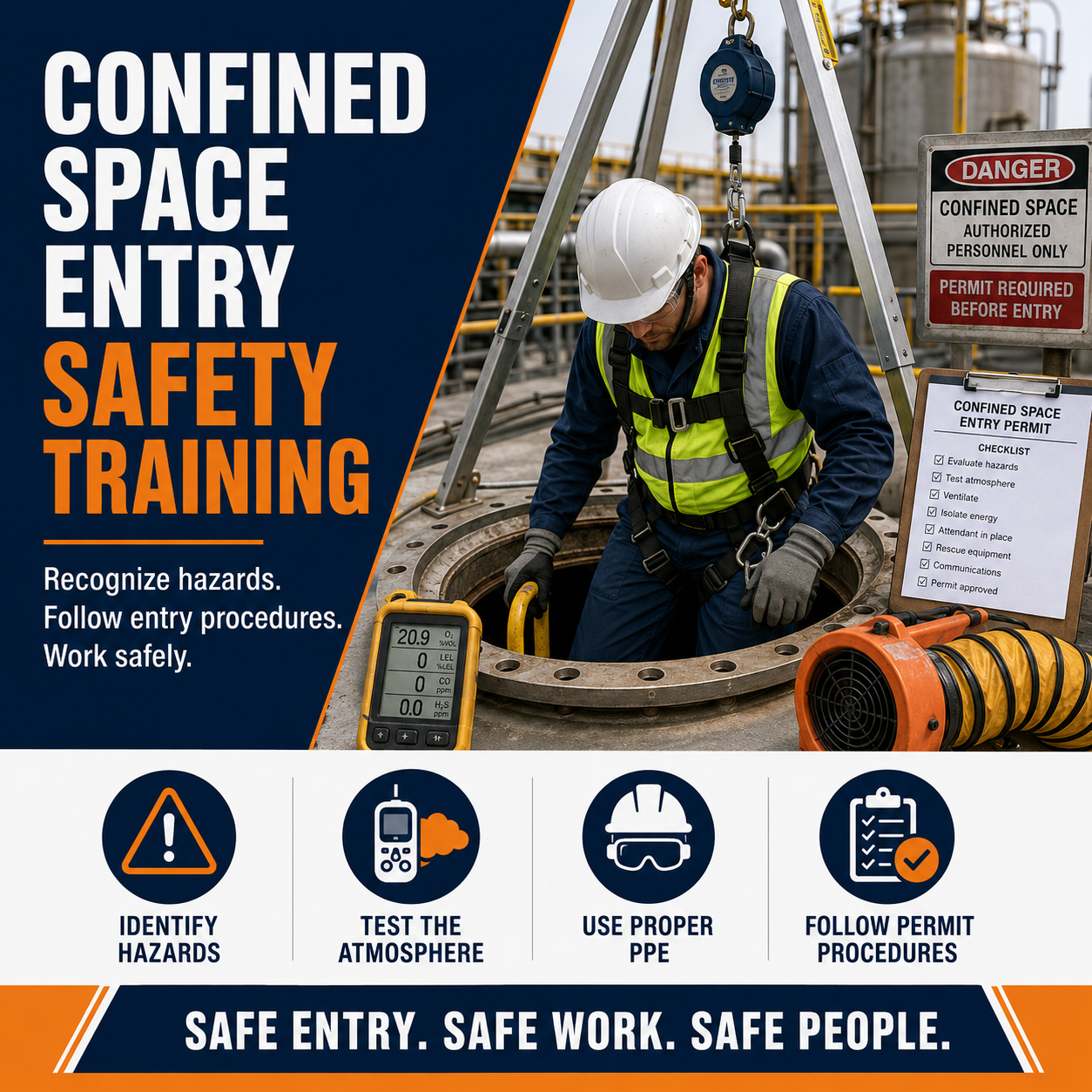
Confined Space Entry Safety Training
Course Overview
Confined-space work can expose workers to rapidly changing atmospheric and physical hazards, often with little margin for error. This course gives learners a practical framework for recognising confined-space risks, controlling entry conditions, and making safer decisions before and during work.
The training focuses on the hazards that can make confined-space entry particularly serious, including oxygen deficiency, toxic or hazardous atmospheres, engulfment, entrapment, uncontrolled energy, restricted access, and inadequate rescue planning. It moves from hazard recognition to practical control measures so learners understand not only what can go wrong, but what a disciplined entry process should look like.
Why This Training Matters
Effective confined-space safety depends on preparation, communication, monitoring, clearly defined roles, and the willingness to stop work when conditions are not safe. A permit or procedure is only effective when the people involved understand how to apply it consistently.
This course helps build that shared understanding. Learners develop greater confidence in entry planning, atmospheric testing, ventilation, isolation, monitoring, contractor coordination, and rescue readiness so that confined-space work can be approached with stronger control and less reliance on assumption.
What This Training Helps You Achieve
Recognise High-Risk Conditions Earlier
Understand the conditions that can make confined spaces hazardous and identify when more formal entry controls are required.
Apply a Disciplined Entry Process
Strengthen practical awareness of testing, ventilation, isolation, permits, continuous monitoring, communication, and stop-work decisions.
Clarify Roles and Responsibilities
Understand how entrants, attendants, entry supervisors, maintenance teams, contractors, and safety personnel work together to keep entry activities controlled.
Strengthen Rescue Readiness
Recognise why rescue planning, retrieval arrangements, communications, and preparation must be established before entry rather than improvised during an emergency.
Learning Outcomes
By the end of this course, learners should be able to:
- Identify confined spaces and recognise conditions that may require permit-controlled entry.
- Explain how atmospheric testing, ventilation, isolation, and continuous monitoring support safer entry.
- Understand the purpose of entry permits and the responsibilities of entrants, attendants, and entry supervisors.
- Recognise the importance of contractor coordination, communication, retrieval systems, and clearly defined entry procedures.
- Describe the key elements of a planned rescue approach and why rescue arrangements should be established before work begins.
- Apply a clearer entry decision process and recognise when conditions require work to stop and be escalated.
Who This Is For
- Authorised entrants who may work inside confined spaces.
- Attendants responsible for monitoring entry activities and maintaining communication.
- Entry supervisors responsible for authorising, coordinating, or overseeing confined-space work.
- Maintenance and operations teams involved in isolation, preparation, inspection, cleaning, or repair activities.
- Contractors working in or around confined spaces.
- Safety professionals and supervisors responsible for entry procedures, training, or oversight.
A disciplined entry process can make the difference between a controlled task and a serious emergency. This course helps teams build the practical awareness and shared working language needed to approach confined-space activities with greater confidence and consistency.
Related Topics
Confined space entry, Confined space entry course, Confined space entry online training, Permit-required confined spaces, Permit-required confined spaces course, Atmospheric testing, Gas monitoring, Ventilation, Hazardous energy isolation, Entry permits, Entrant, attendant, and supervisor roles, Rescue planning, Retrieval systems, Contractor coordination, Emergency response