

Course Overview
Contact Analysis with Finite Elements
Model interfaces where load transfer changes as components touch, slide, separate, and deform.
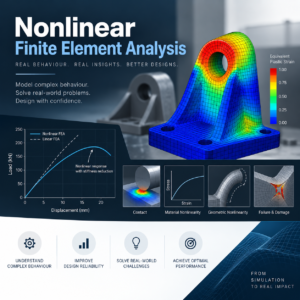
Model contact, separation, sliding, friction, pressure, and nonlinear interaction between components using finite element analysis.
Why This Course Matters
Contact problems are inherently nonlinear and often sensitive to mesh, stiffness, friction, initial clearance, solver settings, and contact formulation. Poor setup can cause convergence problems or misleading local stresses.
Modern engineering teams increasingly need professionals who can connect theory with numerical modelling, simulation setup, verification, result interpretation, design analysis, and technical review. This course is designed to strengthen that capability with practical, engineering-focused learning.
What This Training Helps You Achieve
Model contact, separation, sliding, friction, pressure, and nonlinear interaction between components using finite element analysis. The training helps you apply the subject with stronger technical reasoning, clearer assumptions, and more confidence when supporting real engineering decisions.
Why Engineers Take This Course
Build stronger technical understanding
Strengthen your ability to work confidently with contact mechanics concepts relevant to FEA, while understanding how the underlying assumptions affect practical engineering outcomes.
Apply the method to real engineering problems
Strengthen your ability to work confidently with small-sliding versus finite-sliding formulations, while understanding how the underlying assumptions affect practical engineering outcomes.
Make more defensible engineering decisions
Strengthen your ability to work confidently with verification of contact pressure, force transfer, and displacement, while understanding how the underlying assumptions affect practical engineering outcomes.
What You’ll Explore
- Contact mechanics concepts relevant to FEA
- Contact pairs, surfaces, and interaction definitions
- Normal contact, penetration control, and contact stiffness
- Frictional sliding and tangential behaviour
- Small-sliding versus finite-sliding formulations
- Initial interference, gaps, and assembly preload
- Mesh density and local stress interpretation
- Convergence controls, stabilization, and solver diagnostics
- Verification of contact pressure, force transfer, and displacement
Learning Outcomes
By the end of this course, you will be able to:
- Explain and apply the core principles associated with contact mechanics concepts relevant to FEA.
- Interpret engineering information related to contact pairs, surfaces, and interaction definitions.
- Evaluate practical considerations involving normal contact, penetration control, and contact stiffness.
- Recognise key assumptions, limitations, and risks associated with small-sliding versus finite-sliding formulations.
- Use structured engineering judgement when working with convergence controls, stabilization, and solver diagnostics.
- Connect analysis and technical evidence with verification of contact pressure, force transfer, and displacement.
- Apply the principles and methods covered in this course with greater technical confidence, discipline, and credibility.
Who This Is For
- FEA analysts modelling assemblies and interfaces
- Mechanical and design engineers working with joints and contact
- Engineers analysing bearings, seals, interference fits, or bolted assemblies
- Simulation specialists progressing into nonlinear analysis
- Technical reviewers assessing contact-analysis results
Why Build This Skill Now
Engineering teams are expected to make faster decisions while still demonstrating sound technical judgement, traceability, and awareness of uncertainty. Developing this capability provides a stronger basis for reviewing assumptions, challenging weak conclusions, and contributing more effectively when technical decisions matter.
If you want to strengthen your understanding of this subject, improve the quality of your engineering judgement, and build capability that can be applied across real projects, this course is a strong next step.
Related Topics
FEA contact analysis, contact modelling, frictional contact, nonlinear FEA, contact pressure, contact stiffness, finite sliding, contact convergence, interference fit FEA, assembly simulation, surface contact, contact mechanics, finite element contact, sliding contact, engineering simulation