
Course Overview
Creep & High-Temperature Damage
Assess how time and temperature change material behaviour, damage accumulation, and remaining life.
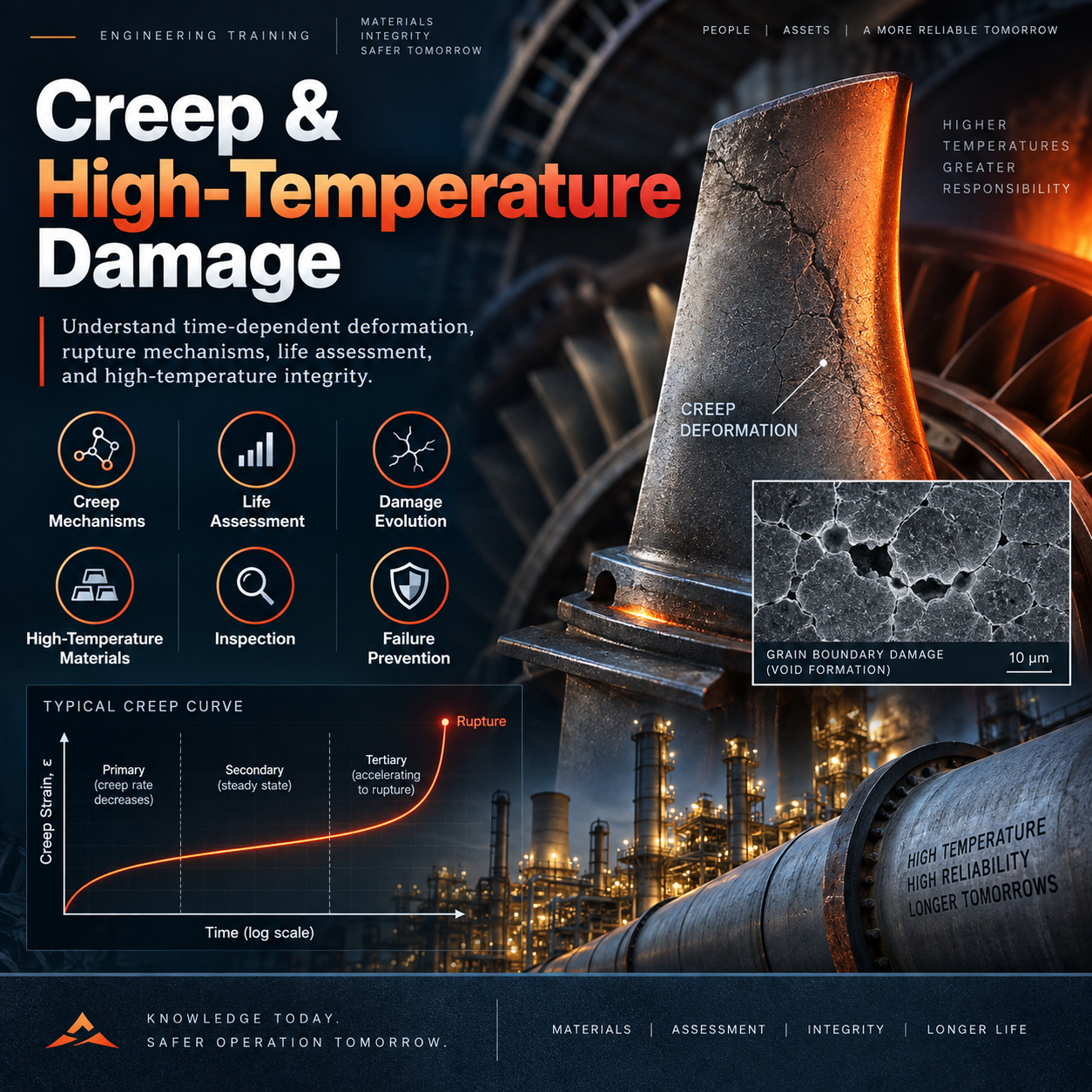
Understand creep deformation, stress rupture, oxidation, thermal ageing, life prediction, and high-temperature damage in engineering materials.
Why This Course Matters
Components operating at elevated temperature can deform and fail under stresses that would be acceptable at room temperature. Creep, oxidation, microstructural ageing, thermal cycling, and creep-fatigue interaction create life-management problems that require time-dependent thinking.
Materials and failure decisions sit at the intersection of design, manufacturing, loading, environment, inspection, and service history. Professionals who can identify damage mechanisms and interpret physical evidence bring greater clarity to reliability, integrity, and root-cause decisions.
This course is designed to close that capability gap with structured, engineering-focused learning that strengthens both technical understanding and professional judgement.
What This Training Helps You Achieve
Understand creep deformation, stress rupture, oxidation, thermal ageing, life prediction, and high-temperature damage in engineering materials. The training is designed to help you apply this knowledge with greater confidence across materials selection, inspection, failure investigation, structural integrity, and life assessment, while making assumptions, limitations, and technical reasoning easier to explain and defend.
Why Engineers Take This Course
Understand time-dependent high-temperature behaviour
Develop stronger capability in creep mechanisms and stages of creep deformation, and use that understanding to support more credible decisions in materials selection, inspection, failure investigation, structural integrity, and life assessment.
Recognise creep and thermal damage mechanisms
Develop stronger capability in oxidation, hot corrosion, and environmental damage, and use that understanding to support more credible decisions in materials selection, inspection, failure investigation, structural integrity, and life assessment.
Support remaining-life and inspection decisions
Develop stronger capability in remaining-life concepts and uncertainty in life prediction, and use that understanding to support more credible decisions in materials selection, inspection, failure investigation, structural integrity, and life assessment.
What You’ll Explore
- Creep mechanisms and stages of creep deformation
- Stress, temperature, and time dependence of creep rate
- Stress-rupture behaviour and creep-life relationships
- High-temperature material selection and microstructural stability
- Oxidation, hot corrosion, and environmental damage
- Creep-fatigue interaction and thermal cycling
- Damage mechanisms in boilers, turbines, piping, and pressure equipment
- Inspection evidence and high-temperature damage assessment
- Remaining-life concepts and uncertainty in life prediction
Learning Outcomes
By the end of this course, you will be able to:
- Explain and apply the core principles associated with creep mechanisms and stages of creep deformation.
- Interpret engineering information related to stress, temperature, and time dependence of creep rate.
- Evaluate practical considerations involving stress-rupture behaviour and creep-life relationships.
- Recognise key assumptions, limitations, and risks associated with oxidation, hot corrosion, and environmental damage.
- Use structured engineering judgement when working with inspection evidence and high-temperature damage assessment.
- Connect analysis and technical evidence with remaining-life concepts and uncertainty in life prediction.
- Approach creep & high-temperature damage work with greater technical confidence, discipline, and credibility.
Who This Is For
- Materials, mechanical, and integrity engineers
- Power-generation, process, and high-temperature equipment engineers
- Reliability and maintenance professionals managing ageing assets
- Engineers performing life assessment or failure investigation
- Technical specialists working with elevated-temperature materials
Why Build This Skill Now
Engineering teams are expected to make faster decisions while still demonstrating sound technical judgement, traceability, and awareness of risk. Building capability in creep & high-temperature damage gives you a stronger basis for reviewing assumptions, challenging weak conclusions, and contributing more effectively when technical decisions matter.
If you want to strengthen your understanding of this subject, improve the quality of your engineering judgement, and build capability that can be applied across real projects, this course is a strong next step.
Related Topics
creep, high temperature damage, creep rupture, stress rupture, creep life assessment, high temperature materials, thermal ageing, oxidation, creep fatigue interaction, remaining life, power plant materials, high temperature failure, materials degradation, creep mechanisms, structural integrity