
Course Overview
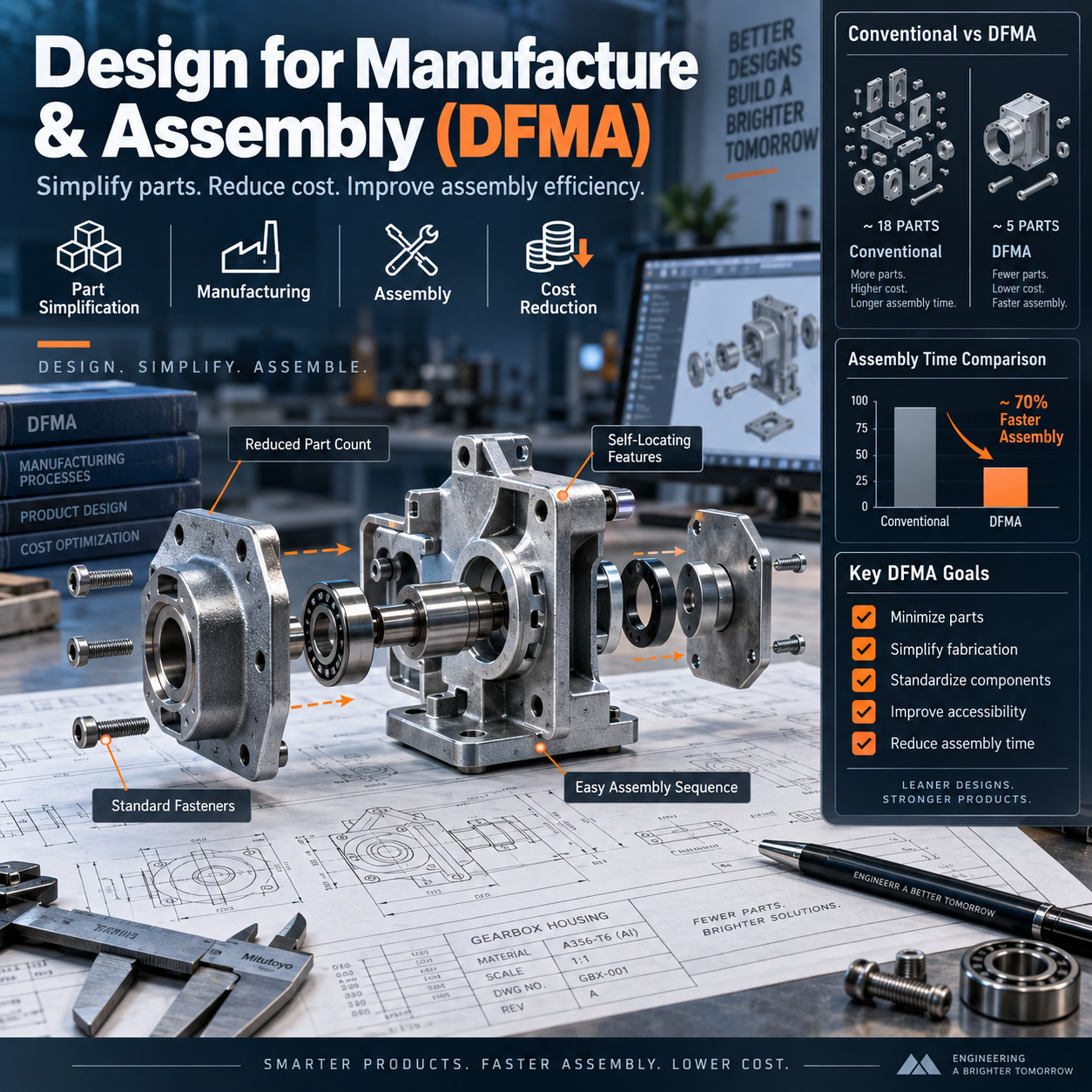
Design for Manufacture & Assembly (DFMA)
Design products that are easier, faster, and more economical to manufacture and assemble.
Apply design principles that reduce manufacturing complexity, assembly effort, cost, and production risk while improving product robustness.
Why This Course Matters
A design can meet its functional requirements and still be expensive, difficult to assemble, sensitive to variation, or dependent on unnecessary operations. DFMA helps engineers consider manufacturing processes, part count, handling, joining, tolerance, and production risk earlier in the design cycle.
Modern mechanical design depends on the ability to translate requirements into geometry, calculations, simulation evidence, manufacturing definition, and verification. The strongest engineers understand both the analytical method and the practical consequences of the design choices they make.
This course is designed to close that capability gap with structured, engineering-focused learning that strengthens both technical understanding and professional judgement.
What This Training Helps You Achieve
Apply design principles that reduce manufacturing complexity, assembly effort, cost, and production risk while improving product robustness. The training is designed to help you apply this knowledge with greater confidence across design, analysis, verification, manufacturing, and engineering review, while making assumptions, limitations, and technical reasoning easier to explain and defend.
Why Engineers Take This Course
Reduce unnecessary product complexity
Develop stronger capability in dfm and dfa principles and their role in product development, and use that understanding to support more credible decisions in design, analysis, verification, manufacturing, and engineering review.
Design around real manufacturing capability
Develop stronger capability in standardisation, modularity, and common-component strategies, and use that understanding to support more credible decisions in design, analysis, verification, manufacturing, and engineering review.
Improve assembly efficiency and cost
Develop stronger capability in dfma reviews and practical redesign methodology, and use that understanding to support more credible decisions in design, analysis, verification, manufacturing, and engineering review.
What You’ll Explore
- DFM and DFA principles and their role in product development
- Part-count reduction and functional integration
- Process-aware design for machining, casting, forming, moulding, and fabrication
- Designing for simple handling, orientation, insertion, and fastening
- Standardisation, modularity, and common-component strategies
- Tolerance, process capability, and avoidable manufacturing precision
- Assembly sequence, access, tooling, and error-proofing
- Cost drivers, value engineering, and design trade-offs
- DFMA reviews and practical redesign methodology
Learning Outcomes
By the end of this course, you will be able to:
- Explain and apply the core principles associated with dfm and dfa principles and their role in product development.
- Interpret engineering information related to part-count reduction and functional integration.
- Evaluate practical considerations involving process-aware design for machining, casting, forming, moulding, and fabrication.
- Recognise key assumptions, limitations, and risks associated with standardisation, modularity, and common-component strategies.
- Use structured engineering judgement when working with cost drivers, value engineering, and design trade-offs.
- Connect analysis and technical evidence with dfma reviews and practical redesign methodology.
- Approach design for manufacture & assembly (dfma) work with greater technical confidence, discipline, and credibility.
Who This Is For
- Mechanical and product design engineers
- Manufacturing, industrial, and production engineers
- Product-development teams seeking lower manufacturing and assembly cost
- Engineers responsible for design transfer into production
- Early-career engineers building practical manufacturability judgement
Why Build This Skill Now
Engineering teams are expected to make faster decisions while still demonstrating sound technical judgement, traceability, and awareness of risk. Building capability in design for manufacture & assembly (dfma) gives you a stronger basis for reviewing assumptions, challenging weak conclusions, and contributing more effectively when technical decisions matter.
If you want to strengthen your understanding of this subject, improve the quality of your engineering judgement, and build capability that can be applied across real projects, this course is a strong next step.
Related Topics
DFMA, design for manufacturing, design for assembly, manufacturing design, product design, assembly optimisation, manufacturing cost reduction, design simplification, production engineering, manufacturability, assembly efficiency, value engineering, mechanical design, product development, lean design