
Course Overview
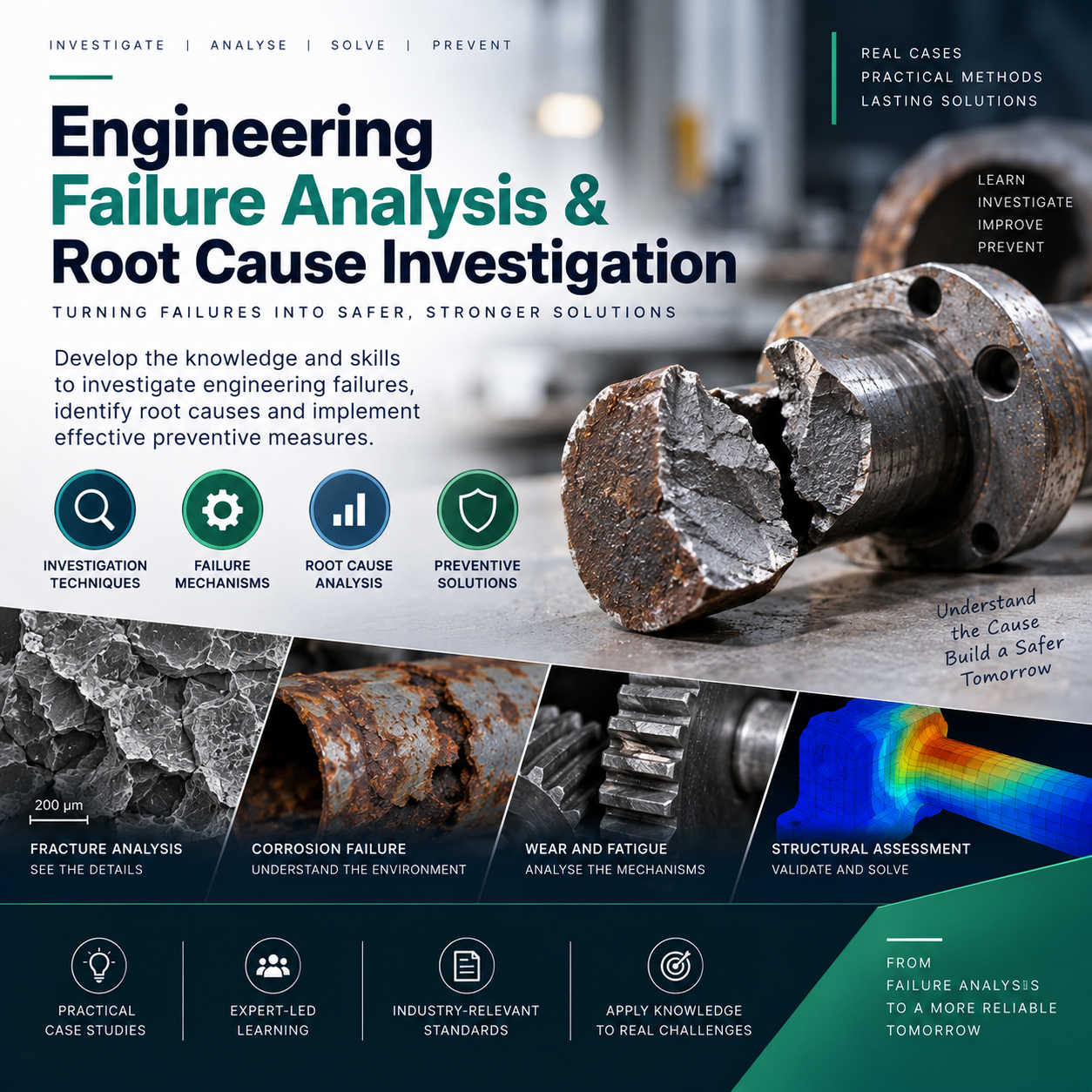
Engineering Failure Analysis & Root Cause Investigation
Investigate failures systematically, distinguish symptoms from causes, and turn evidence into effective corrective action.
Learn a systematic process for investigating engineering failures, gathering evidence, identifying mechanisms, determining root causes, and preventing recurrence.
Why This Course Matters
Failed components rarely have a single obvious cause. Loading, material condition, manufacturing defects, environment, maintenance, human factors, and design assumptions can interact. A disciplined failure investigation preserves evidence, identifies the active mechanisms, tests competing hypotheses, and prevents recurrence.
Materials and failure decisions sit at the intersection of design, manufacturing, loading, environment, inspection, and service history. Professionals who can identify damage mechanisms and interpret physical evidence bring greater clarity to reliability, integrity, and root-cause decisions.
This course is designed to close that capability gap with structured, engineering-focused learning that strengthens both technical understanding and professional judgement.
What This Training Helps You Achieve
Learn a systematic process for investigating engineering failures, gathering evidence, identifying mechanisms, determining root causes, and preventing recurrence. The training is designed to help you apply this knowledge with greater confidence across materials selection, inspection, failure investigation, structural integrity, and life assessment, while making assumptions, limitations, and technical reasoning easier to explain and defend.
Why Engineers Take This Course
Preserve and interpret failure evidence
Develop stronger capability in failure-analysis process, investigation planning, and evidence preservation, and use that understanding to support more credible decisions in materials selection, inspection, failure investigation, structural integrity, and life assessment.
Separate failure mechanisms from root causes
Develop stronger capability in use of materials testing, microscopy, ndt, and analytical methods, and use that understanding to support more credible decisions in materials selection, inspection, failure investigation, structural integrity, and life assessment.
Turn investigation findings into effective corrective action
Develop stronger capability in communicating findings in defensible engineering failure reports, and use that understanding to support more credible decisions in materials selection, inspection, failure investigation, structural integrity, and life assessment.
What You’ll Explore
- Failure-analysis process, investigation planning, and evidence preservation
- Defining the failure event, service history, and operating conditions
- Visual examination, documentation, and fracture-location mapping
- Mechanical, metallurgical, environmental, and manufacturing failure mechanisms
- Use of materials testing, microscopy, NDT, and analytical methods
- Fault trees, 5 Whys, causal-factor thinking, and hypothesis testing
- Distinguishing root causes, contributing factors, and consequences
- Corrective and preventive actions and effectiveness checks
- Communicating findings in defensible engineering failure reports
Learning Outcomes
By the end of this course, you will be able to:
- Explain and apply the core principles associated with failure-analysis process, investigation planning, and evidence preservation.
- Interpret engineering information related to defining the failure event, service history, and operating conditions.
- Evaluate practical considerations involving visual examination, documentation, and fracture-location mapping.
- Recognise key assumptions, limitations, and risks associated with use of materials testing, microscopy, ndt, and analytical methods.
- Use structured engineering judgement when working with corrective and preventive actions and effectiveness checks.
- Connect analysis and technical evidence with communicating findings in defensible engineering failure reports.
- Approach engineering failure analysis & root cause investigation work with greater technical confidence, discipline, and credibility.
Who This Is For
- Mechanical, materials, structural, and reliability engineers
- Engineers responsible for investigating failed equipment or components
- Quality and manufacturing professionals involved in technical root-cause analysis
- Maintenance and asset-integrity teams
- Technical leaders who review failure investigations and corrective actions
Why Build This Skill Now
Engineering teams are expected to make faster decisions while still demonstrating sound technical judgement, traceability, and awareness of risk. Building capability in engineering failure analysis & root cause investigation gives you a stronger basis for reviewing assumptions, challenging weak conclusions, and contributing more effectively when technical decisions matter.
If you want to strengthen your understanding of this subject, improve the quality of your engineering judgement, and build capability that can be applied across real projects, this course is a strong next step.
Related Topics
failure analysis, root cause analysis, engineering failure investigation, RCA, failure investigation, fracture analysis, failure mechanisms, metallurgical failure analysis, component failure, engineering forensics, 5 whys, fault tree analysis, corrective action, failure prevention, structural integrity