
Course Overview
Finite Element Analysis for Mechanical Engineers
Use FEA as an engineering method — not just a software output.
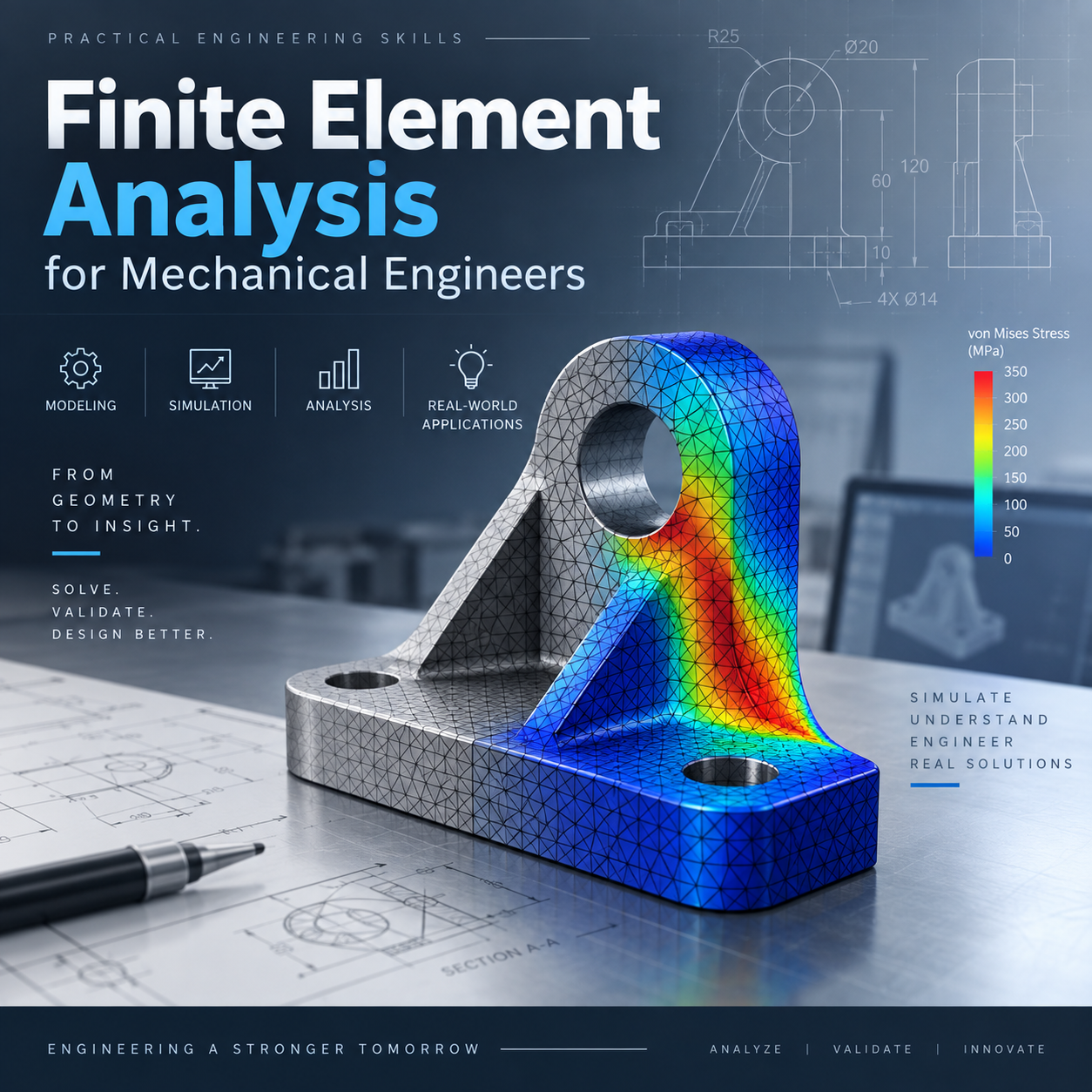
Build practical capability in finite element modelling, meshing, boundary conditions, result interpretation, verification, and common analysis pitfalls.
Why This Course Matters
Finite Element Analysis can reveal structural behaviour that is difficult to calculate by hand, but inaccurate assumptions, poor meshes, unrealistic boundary conditions, or weak result interpretation can make a polished model misleading. Engineers need a disciplined workflow that connects mechanics, modelling choices, verification, and engineering judgement.
Modern mechanical design depends on the ability to translate requirements into geometry, calculations, simulation evidence, manufacturing definition, and verification. The strongest engineers understand both the analytical method and the practical consequences of the design choices they make.
This course is designed to close that capability gap with structured, engineering-focused learning that strengthens both technical understanding and professional judgement.
What This Training Helps You Achieve
Build practical capability in finite element modelling, meshing, boundary conditions, result interpretation, verification, and common analysis pitfalls. The training is designed to help you apply this knowledge with greater confidence across design, analysis, verification, manufacturing, and engineering review, while making assumptions, limitations, and technical reasoning easier to explain and defend.
Why Engineers Take This Course
Build defensible finite element models
Develop stronger capability in finite element method fundamentals and the role of idealisation, and use that understanding to support more credible decisions in design, analysis, verification, manufacturing, and engineering review.
Recognise when results can be trusted
Develop stronger capability in meshing strategy, element quality, local refinement, and convergence, and use that understanding to support more credible decisions in design, analysis, verification, manufacturing, and engineering review.
Connect simulation output to engineering mechanics
Develop stronger capability in model validation, sensitivity studies, documentation, and defensible reporting, and use that understanding to support more credible decisions in design, analysis, verification, manufacturing, and engineering review.
What You’ll Explore
- Finite element method fundamentals and the role of idealisation
- Element types, degrees of freedom, and model dimensionality
- Geometry preparation and modelling simplifications
- Material models, loads, constraints, contacts, and boundary conditions
- Meshing strategy, element quality, local refinement, and convergence
- Linear static stress and deformation analysis
- Result interpretation, stress singularities, averaging, and hot-spot assessment
- Hand calculations, equilibrium checks, mesh convergence, and verification
- Model validation, sensitivity studies, documentation, and defensible reporting
Learning Outcomes
By the end of this course, you will be able to:
- Explain and apply the core principles associated with finite element method fundamentals and the role of idealisation.
- Interpret engineering information related to element types, degrees of freedom, and model dimensionality.
- Evaluate practical considerations involving geometry preparation and modelling simplifications.
- Recognise key assumptions, limitations, and risks associated with meshing strategy, element quality, local refinement, and convergence.
- Use structured engineering judgement when working with hand calculations, equilibrium checks, mesh convergence, and verification.
- Connect analysis and technical evidence with model validation, sensitivity studies, documentation, and defensible reporting.
- Approach finite element analysis for mechanical engineers work with greater technical confidence, discipline, and credibility.
Who This Is For
- Mechanical and structural engineers using or reviewing FEA
- Design engineers who need more confidence in simulation-led decisions
- Analysts seeking a stronger foundation in model setup and verification
- Engineers transitioning from hand calculations to numerical analysis
- Professionals responsible for reviewing supplier or consultant FEA results
Why Build This Skill Now
Engineering teams are expected to make faster decisions while still demonstrating sound technical judgement, traceability, and awareness of risk. Building capability in finite element analysis for mechanical engineers gives you a stronger basis for reviewing assumptions, challenging weak conclusions, and contributing more effectively when technical decisions matter.
If you want to strengthen your understanding of this subject, improve the quality of your engineering judgement, and build capability that can be applied across real projects, this course is a strong next step.
Related Topics
finite element analysis, FEA, mechanical FEA, structural analysis, FEA modelling, meshing, boundary conditions, stress analysis, finite element method, FEA verification, simulation engineering, ANSYS fundamentals, Abaqus fundamentals, structural simulation, FEA results interpretation