
Course Overview
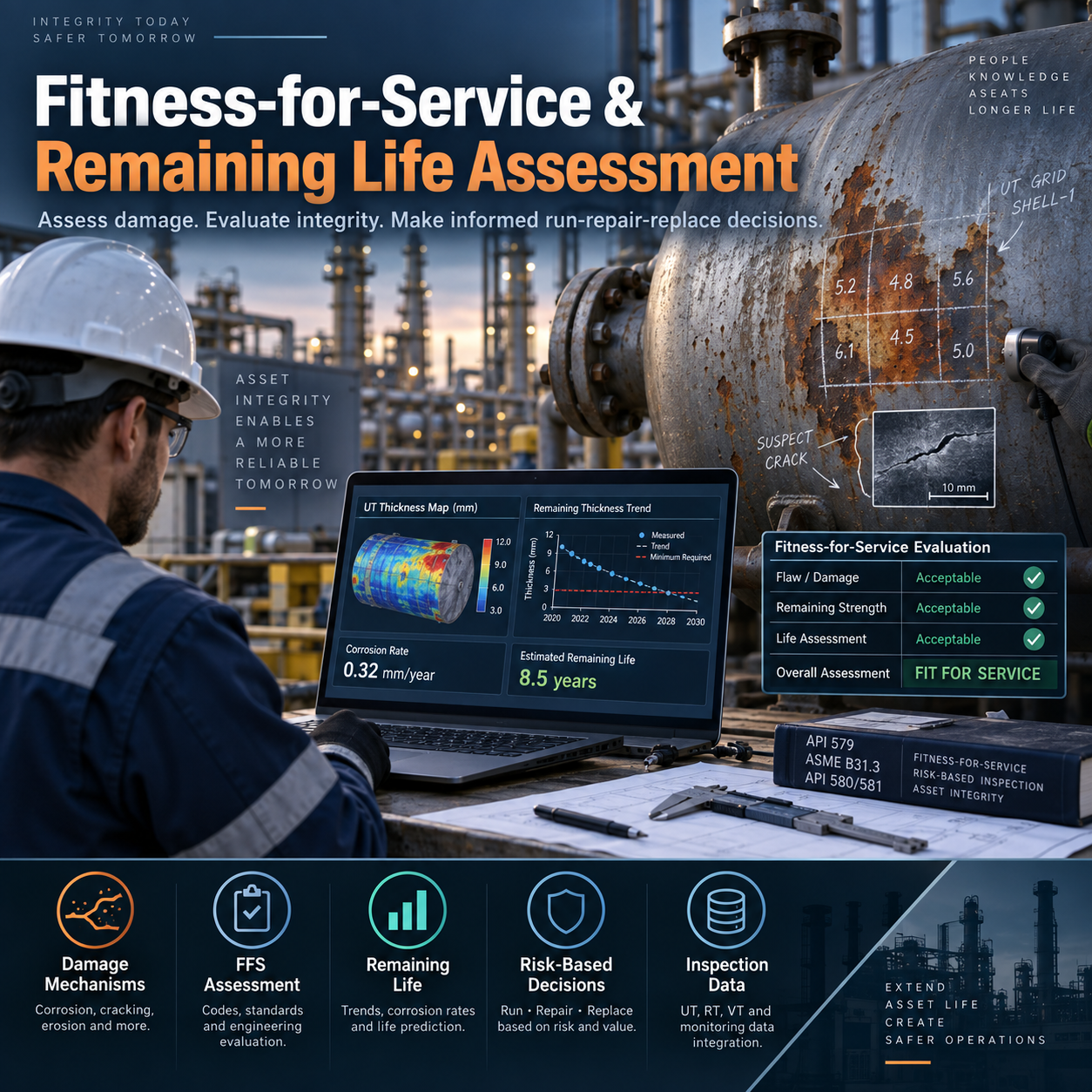
Fitness-for-Service & Remaining Life Assessment
Make more informed decisions about damaged equipment, continued operation, inspection, repair, and life extension.
Learn engineering approaches for evaluating defects, degradation, continued operation, remaining life, inspection intervals, and repair decisions.
Why This Course Matters
Finding a defect does not automatically mean a component must be replaced, and passing a simple code check does not always mean continued operation is safe. Fitness-for-service assessment connects defect size, stress, material resistance, damage mechanism, inspection quality, and future growth.
Materials and failure decisions sit at the intersection of design, manufacturing, loading, environment, inspection, and service history. Professionals who can identify damage mechanisms and interpret physical evidence bring greater clarity to reliability, integrity, and root-cause decisions.
This course is designed to close that capability gap with structured, engineering-focused learning that strengthens both technical understanding and professional judgement.
What This Training Helps You Achieve
Learn engineering approaches for evaluating defects, degradation, continued operation, remaining life, inspection intervals, and repair decisions. The training is designed to help you apply this knowledge with greater confidence across materials selection, inspection, failure investigation, structural integrity, and life assessment, while making assumptions, limitations, and technical reasoning easier to explain and defend.
Why Engineers Take This Course
Assess defects in the context of continued operation
Develop stronger capability in purpose and levels of fitness-for-service assessment, and use that understanding to support more credible decisions in materials selection, inspection, failure investigation, structural integrity, and life assessment.
Connect damage mechanisms to remaining life
Develop stronger capability in remaining strength and failure-mode thinking, and use that understanding to support more credible decisions in materials selection, inspection, failure investigation, structural integrity, and life assessment.
Support repair, inspection, and life-extension decisions
Develop stronger capability in introduction to recognised ffs frameworks including api 579-1/asme ffs-1 concepts, and use that understanding to support more credible decisions in materials selection, inspection, failure investigation, structural integrity, and life assessment.
What You’ll Explore
- Purpose and levels of fitness-for-service assessment
- Damage mechanisms, flaw characterisation, and required input data
- Local metal loss and general corrosion assessment concepts
- Crack-like flaws and fracture-mechanics-based assessment
- Remaining strength and failure-mode thinking
- Fatigue crack growth and remaining-life estimation
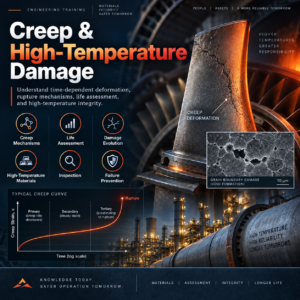
- Creep and high-temperature damage considerations
- Inspection intervals, uncertainty, monitoring, repair, and rerating
- Introduction to recognised FFS frameworks including API 579-1/ASME FFS-1 concepts
Learning Outcomes
By the end of this course, you will be able to:
- Explain and apply the core principles associated with purpose and levels of fitness-for-service assessment.
- Interpret engineering information related to damage mechanisms, flaw characterisation, and required input data.
- Evaluate practical considerations involving local metal loss and general corrosion assessment concepts.
- Recognise key assumptions, limitations, and risks associated with remaining strength and failure-mode thinking.
- Use structured engineering judgement when working with inspection intervals, uncertainty, monitoring, repair, and rerating.
- Connect analysis and technical evidence with introduction to recognised ffs frameworks including api 579-1/asme ffs-1 concepts.
- Approach fitness-for-service & remaining life assessment work with greater technical confidence, discipline, and credibility.
Who This Is For
- Asset-integrity, mechanical, and materials engineers
- Inspection and reliability professionals
- Engineers responsible for pressure equipment, piping, structures, or ageing assets
- Failure-analysis and fracture-mechanics practitioners
- Technical authorities involved in repair, rerating, or continued-operation decisions
Why Build This Skill Now
Engineering teams are expected to make faster decisions while still demonstrating sound technical judgement, traceability, and awareness of risk. Building capability in fitness-for-service & remaining life assessment gives you a stronger basis for reviewing assumptions, challenging weak conclusions, and contributing more effectively when technical decisions matter.
If you want to strengthen your understanding of this subject, improve the quality of your engineering judgement, and build capability that can be applied across real projects, this course is a strong next step.
Related Topics
fitness for service, FFS, remaining life assessment, API 579, ASME FFS-1, defect assessment, crack assessment, corrosion assessment, structural integrity, remaining life, asset integrity, engineering critical assessment, ECA, continued operation, life extension