
Course Overview
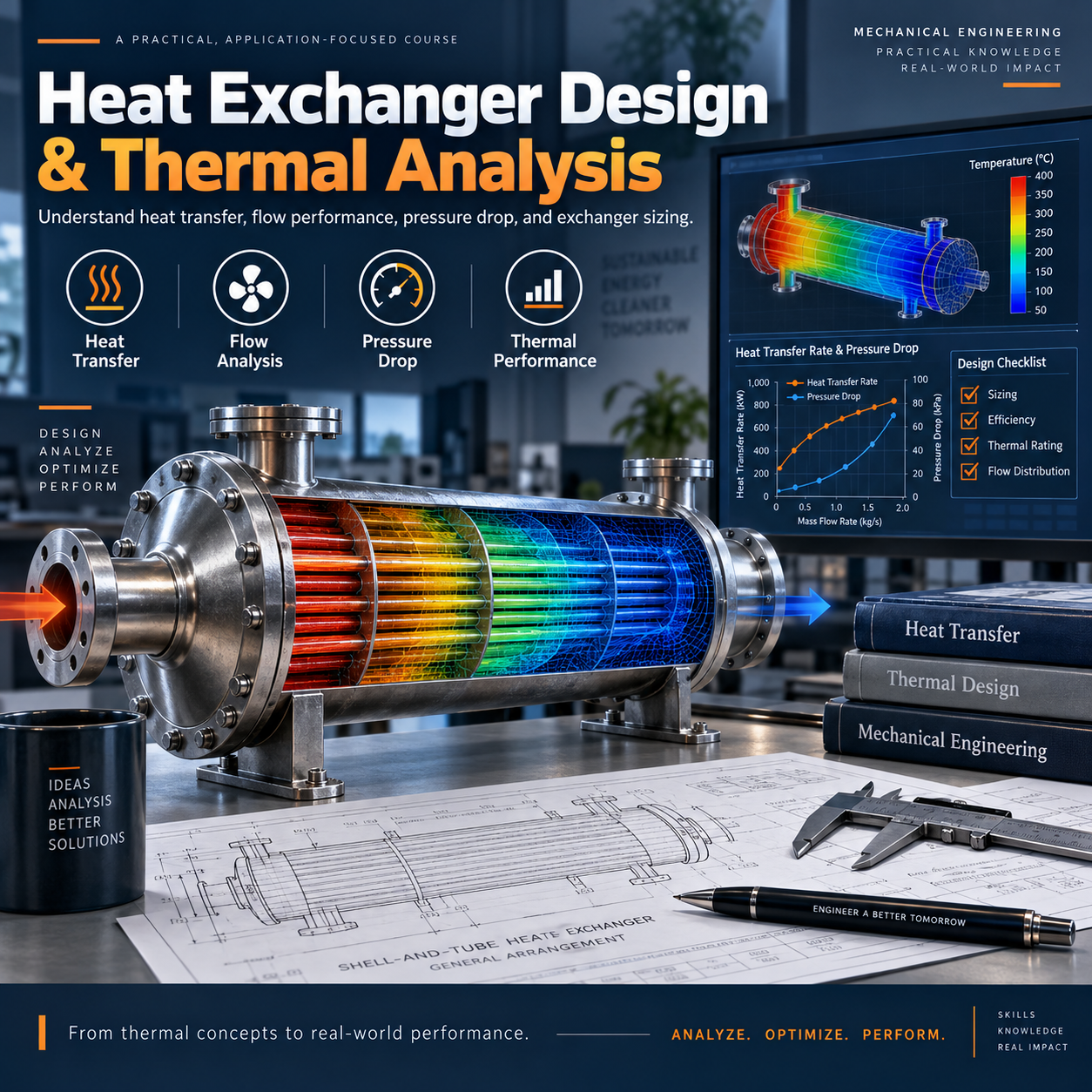
Heat Exchanger Design & Thermal Analysis
Size and assess heat exchangers using sound thermal reasoning, realistic performance assumptions, and practical engineering trade-offs.
Learn thermal sizing and performance analysis of common heat exchangers using energy balances, LMTD, effectiveness, and pressure-drop considerations.
Why This Course Matters
Heat exchangers sit at the centre of power, process, HVAC, refrigeration, and heat-recovery systems. Poor thermal sizing, fouling assumptions, pressure-drop estimates, or flow arrangements can reduce performance and create avoidable operating cost.
Energy projects increasingly demand engineers who can connect fundamental physics with equipment behaviour, system integration, efficiency, lifecycle performance, and technical economics. A stronger systems view helps professionals evaluate technologies more critically and support more defensible energy decisions.
This course is designed to close that capability gap with structured, engineering-focused learning that strengthens both technical understanding and professional judgement.
What This Training Helps You Achieve
Learn thermal sizing and performance analysis of common heat exchangers using energy balances, LMTD, effectiveness, and pressure-drop considerations. The training is designed to help you apply this knowledge with greater confidence across system design, performance assessment, integration, operations, and project evaluation, while making assumptions, limitations, and technical reasoning easier to explain and defend.
Why Engineers Take This Course
Size exchangers from credible thermal assumptions
Develop stronger capability in heat-exchanger types, configurations, and selection criteria, and use that understanding to support more credible decisions in system design, performance assessment, integration, operations, and project evaluation.
Compare flow arrangements and methods
Develop stronger capability in parallel, counterflow, crossflow, and multi-pass arrangements, and use that understanding to support more credible decisions in system design, performance assessment, integration, operations, and project evaluation.
Balance heat duty against pressure drop and fouling
Develop stronger capability in sizing, rating, performance assessment, and operating diagnostics, and use that understanding to support more credible decisions in system design, performance assessment, integration, operations, and project evaluation.
What You’ll Explore
- Heat-exchanger types, configurations, and selection criteria
- Energy balances and overall heat-transfer coefficient
- Log mean temperature difference method
- Effectiveness-NTU method
- Parallel, counterflow, crossflow, and multi-pass arrangements
- Shell-and-tube and plate heat-exchanger fundamentals
- Fouling, thermal resistance, and performance degradation
- Pressure drop, pumping implications, and thermal-hydraulic trade-offs
- Sizing, rating, performance assessment, and operating diagnostics
Learning Outcomes
By the end of this course, you will be able to:
- Explain and apply the core principles associated with heat-exchanger types, configurations, and selection criteria.
- Interpret engineering information related to energy balances and overall heat-transfer coefficient.
- Evaluate practical considerations involving log mean temperature difference method.
- Recognise key assumptions, limitations, and risks associated with parallel, counterflow, crossflow, and multi-pass arrangements.
- Use structured engineering judgement when working with pressure drop, pumping implications, and thermal-hydraulic trade-offs.
- Connect analysis and technical evidence with sizing, rating, performance assessment, and operating diagnostics.
- Approach heat exchanger design & thermal analysis work with greater technical confidence, discipline, and credibility.
Who This Is For
- Mechanical, process, and energy engineers
- Engineers working with HVAC, power, refrigeration, or industrial heat recovery
- Design engineers sizing thermal equipment
- Plant engineers evaluating exchanger performance problems
- Professionals seeking applied heat-transfer and equipment-design capability
Why Build This Skill Now
Engineering teams are expected to make faster decisions while still demonstrating sound technical judgement, traceability, and awareness of risk. Building capability in heat exchanger design & thermal analysis gives you a stronger basis for reviewing assumptions, challenging weak conclusions, and contributing more effectively when technical decisions matter.
If you want to strengthen your understanding of this subject, improve the quality of your engineering judgement, and build capability that can be applied across real projects, this course is a strong next step.
Related Topics
heat exchanger design, heat exchanger analysis, LMTD, effectiveness NTU, shell and tube heat exchanger, plate heat exchanger, thermal design, heat transfer, pressure drop, heat exchanger sizing, thermal performance, energy systems, fouling factor, process heat transfer, thermal engineering