
Course Overview
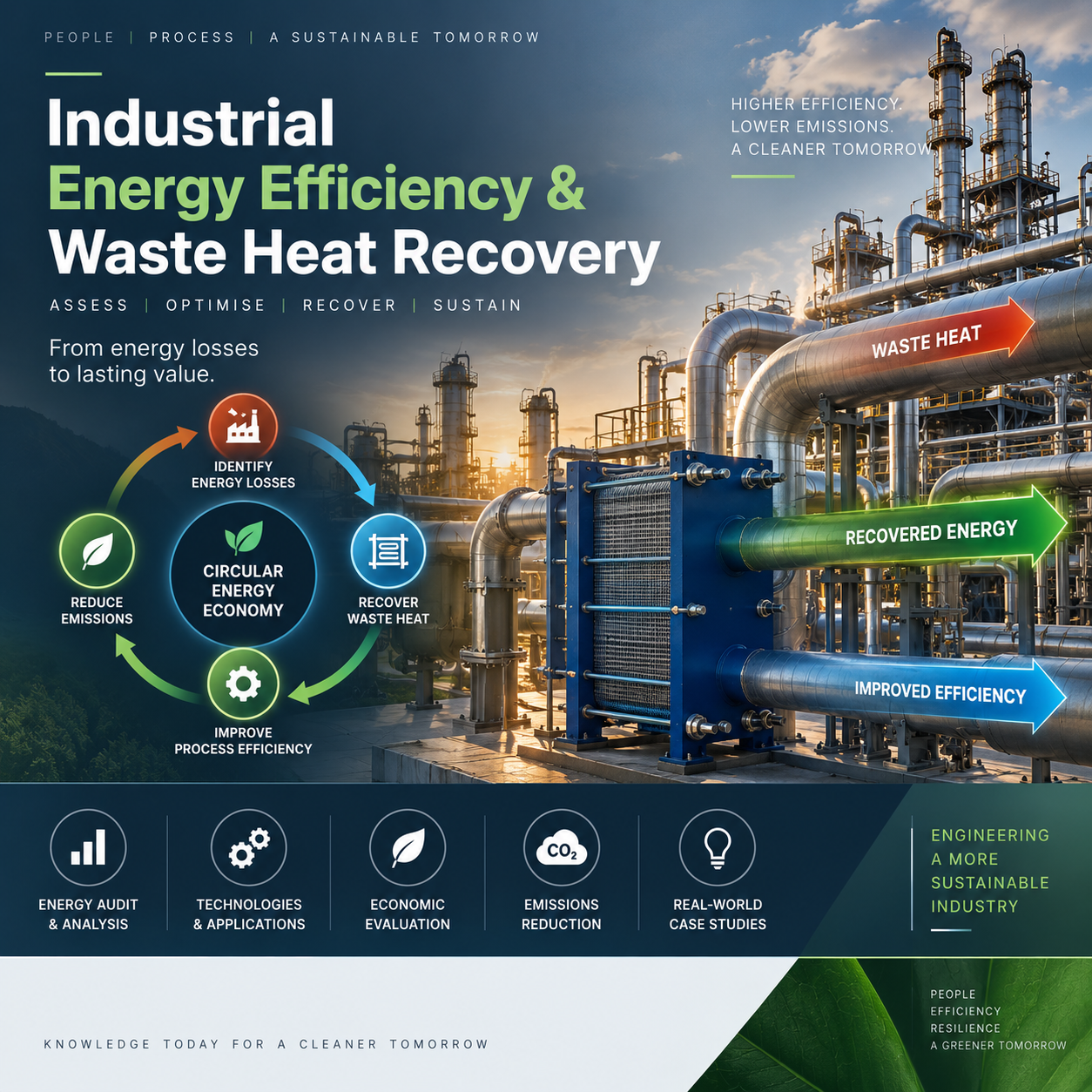
Industrial Energy Efficiency & Waste Heat Recovery
Find, quantify, and prioritise practical energy-saving opportunities across industrial systems.
Identify and evaluate industrial energy-saving opportunities, heat recovery options, utility losses, and practical efficiency improvement projects.
Why This Course Matters
Industrial facilities often lose energy through inefficient combustion, steam leaks, compressed air, poorly controlled motors, uninsulated surfaces, rejected heat, and weak operating practices. Engineers need a structured approach to identify losses, quantify savings, and judge whether recovery projects are technically and economically worthwhile.
Energy projects increasingly demand engineers who can connect fundamental physics with equipment behaviour, system integration, efficiency, lifecycle performance, and technical economics. A stronger systems view helps professionals evaluate technologies more critically and support more defensible energy decisions.
This course is designed to close that capability gap with structured, engineering-focused learning that strengthens both technical understanding and professional judgement.
What This Training Helps You Achieve
Identify and evaluate industrial energy-saving opportunities, heat recovery options, utility losses, and practical efficiency improvement projects. The training is designed to help you apply this knowledge with greater confidence across system design, performance assessment, integration, operations, and project evaluation, while making assumptions, limitations, and technical reasoning easier to explain and defend.
Why Engineers Take This Course
Find where industrial energy is being lost
Develop stronger capability in industrial energy balances and energy-use mapping, and use that understanding to support more credible decisions in system design, performance assessment, integration, operations, and project evaluation.
Quantify practical recovery opportunities
Develop stronger capability in motors, drives, pumps, fans, and variable-speed opportunities, and use that understanding to support more credible decisions in system design, performance assessment, integration, operations, and project evaluation.
Prioritise projects with technical and economic value
Develop stronger capability in savings estimation, implementation priorities, and project economics, and use that understanding to support more credible decisions in system design, performance assessment, integration, operations, and project evaluation.
What You’ll Explore
- Industrial energy balances and energy-use mapping
- Energy auditing, baselines, metering, and performance indicators
- Boilers, steam systems, condensate, and combustion efficiency
- Compressed-air generation, distribution, leakage, and control
- Motors, drives, pumps, fans, and variable-speed opportunities
- Insulation and reduction of avoidable thermal losses
- Waste-heat sources, temperature levels, and recovery options
- Heat exchangers, economisers, heat pumps, and recovery integration
- Savings estimation, implementation priorities, and project economics
Learning Outcomes
By the end of this course, you will be able to:
- Explain and apply the core principles associated with industrial energy balances and energy-use mapping.
- Interpret engineering information related to energy auditing, baselines, metering, and performance indicators.
- Evaluate practical considerations involving boilers, steam systems, condensate, and combustion efficiency.
- Recognise key assumptions, limitations, and risks associated with motors, drives, pumps, fans, and variable-speed opportunities.
- Use structured engineering judgement when working with heat exchangers, economisers, heat pumps, and recovery integration.
- Connect analysis and technical evidence with savings estimation, implementation priorities, and project economics.
- Approach industrial energy efficiency & waste heat recovery work with greater technical confidence, discipline, and credibility.
Who This Is For
- Energy managers and industrial engineers
- Plant, facilities, maintenance, and utilities engineers
- Process engineers seeking lower energy consumption and operating cost
- Sustainability professionals working with technical decarbonisation measures
- Consultants and engineers conducting energy-efficiency assessments
Why Build This Skill Now
Engineering teams are expected to make faster decisions while still demonstrating sound technical judgement, traceability, and awareness of risk. Building capability in industrial energy efficiency & waste heat recovery gives you a stronger basis for reviewing assumptions, challenging weak conclusions, and contributing more effectively when technical decisions matter.
If you want to strengthen your understanding of this subject, improve the quality of your engineering judgement, and build capability that can be applied across real projects, this course is a strong next step.
Related Topics
industrial energy efficiency, waste heat recovery, energy audit, energy management, industrial utilities, energy conservation, heat recovery, energy savings, process efficiency, thermal efficiency, industrial decarbonisation, energy optimisation, steam system efficiency, compressed air efficiency, energy engineering