
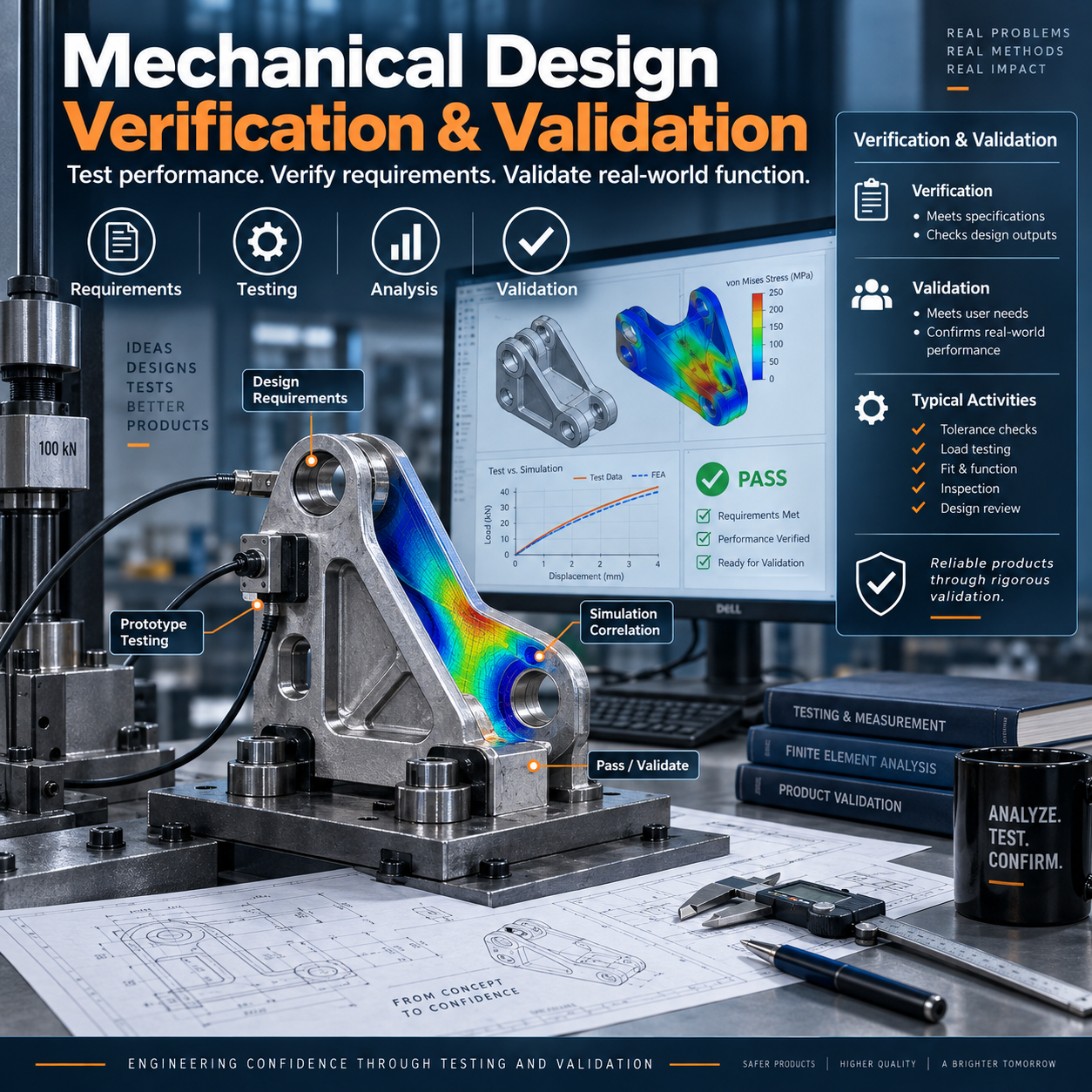
Course Overview
Mechanical Design Verification & Validation
Demonstrate that a mechanical design is correct, fit for purpose, and supported by credible evidence.
Learn structured methods for verifying calculations, validating design performance, managing requirements, and demonstrating design compliance.
Why This Course Matters
A design is not complete because the CAD model is released or an analysis converges. Engineering teams need traceable evidence that requirements have been interpreted correctly, calculations and simulations are verified, performance is validated, risks are addressed, and acceptance criteria are met.
Modern mechanical design depends on the ability to translate requirements into geometry, calculations, simulation evidence, manufacturing definition, and verification. The strongest engineers understand both the analytical method and the practical consequences of the design choices they make.
This course is designed to close that capability gap with structured, engineering-focused learning that strengthens both technical understanding and professional judgement.
What This Training Helps You Achieve
Learn structured methods for verifying calculations, validating design performance, managing requirements, and demonstrating design compliance. The training is designed to help you apply this knowledge with greater confidence across design, analysis, verification, manufacturing, and engineering review, while making assumptions, limitations, and technical reasoning easier to explain and defend.
Why Engineers Take This Course
Turn requirements into verifiable evidence
Develop stronger capability in difference between verification, validation, qualification, and acceptance, and use that understanding to support more credible decisions in design, analysis, verification, manufacturing, and engineering review.
Strengthen analysis and test credibility
Develop stronger capability in simulation verification and model validation principles, and use that understanding to support more credible decisions in design, analysis, verification, manufacturing, and engineering review.
Build traceable design assurance
Develop stronger capability in building a defensible verification and validation strategy, and use that understanding to support more credible decisions in design, analysis, verification, manufacturing, and engineering review.
What You’ll Explore
- Difference between verification, validation, qualification, and acceptance
- Translating stakeholder needs into measurable engineering requirements
- Verification planning and requirement traceability
- Calculation checking, independent review, and design margins
- Simulation verification and model validation principles
- Test planning, instrumentation, uncertainty, and acceptance criteria
- Design reviews, failure-mode thinking, and technical risk closure
- Configuration control, evidence management, and verification records
- Building a defensible verification and validation strategy
Learning Outcomes
By the end of this course, you will be able to:
- Explain and apply the core principles associated with difference between verification, validation, qualification, and acceptance.
- Interpret engineering information related to translating stakeholder needs into measurable engineering requirements.
- Evaluate practical considerations involving verification planning and requirement traceability.
- Recognise key assumptions, limitations, and risks associated with simulation verification and model validation principles.
- Use structured engineering judgement when working with configuration control, evidence management, and verification records.
- Connect analysis and technical evidence with building a defensible verification and validation strategy.
- Approach mechanical design verification & validation work with greater technical confidence, discipline, and credibility.
Who This Is For
- Mechanical and systems engineers responsible for design assurance
- Design authorities, lead engineers, and technical reviewers
- Project engineers coordinating analysis and testing activities
- Product-development teams working in regulated or high-consequence sectors
- Engineers who need stronger evidence-based design decisions
Why Build This Skill Now
Engineering teams are expected to make faster decisions while still demonstrating sound technical judgement, traceability, and awareness of risk. Building capability in mechanical design verification & validation gives you a stronger basis for reviewing assumptions, challenging weak conclusions, and contributing more effectively when technical decisions matter.
If you want to strengthen your understanding of this subject, improve the quality of your engineering judgement, and build capability that can be applied across real projects, this course is a strong next step.
Related Topics
design verification, design validation, mechanical design, engineering validation, design assurance, requirements verification, test validation, engineering calculations, design review, verification planning, validation testing, engineering compliance, product verification, design documentation, engineering assurance