

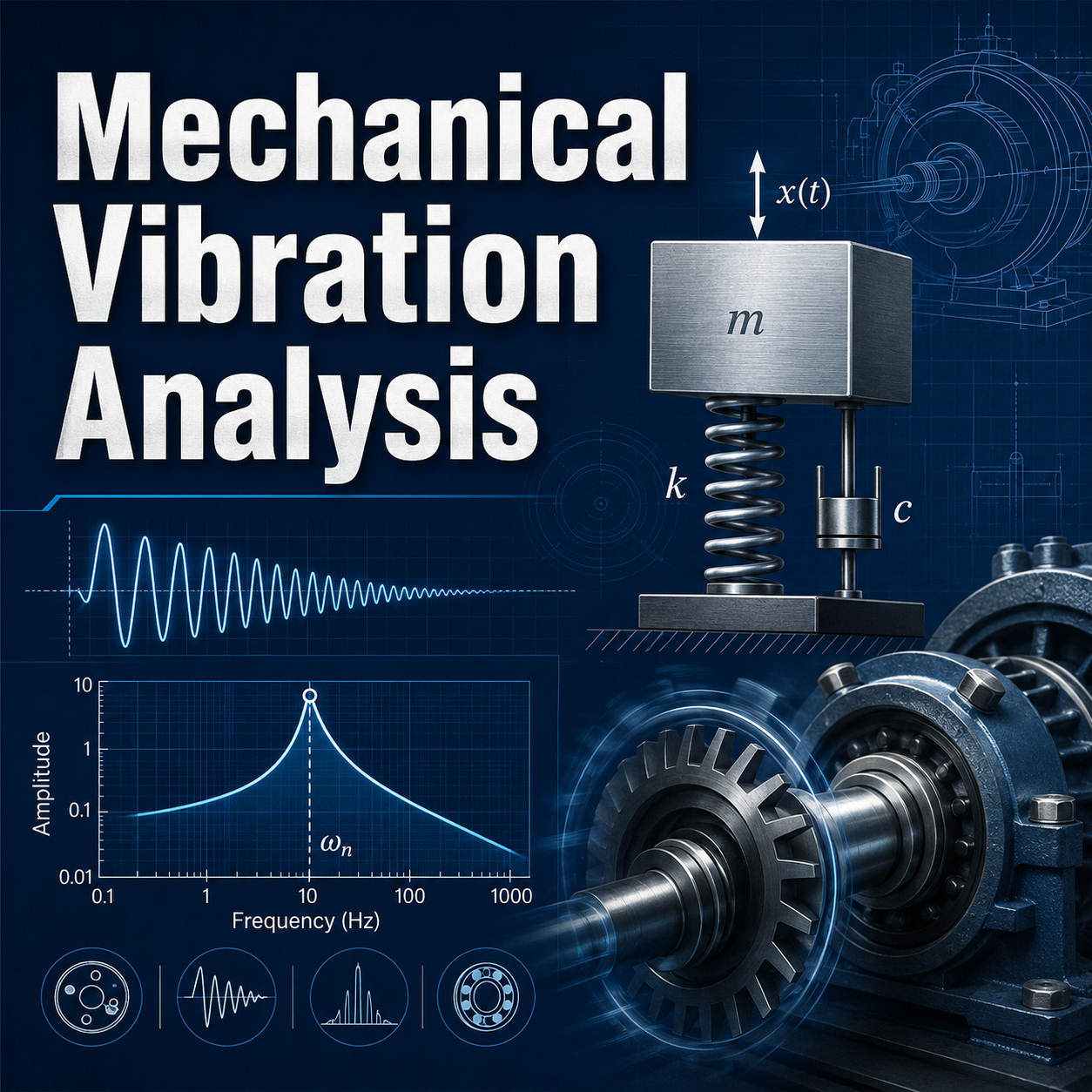
Mechanical Vibration Analysis & Troubleshooting
Course Overview
Learn how to predict, analyse, and reduce vibration problems before they become costly failures.
Build the confidence to calculate natural frequencies, evaluate dynamic response, and design practical solutions to reduce vibration in new and existing systems — so you can make stronger engineering decisions and solve real-world problems with authority.
Why This Course Matters
Uncontrolled vibration is not just a technical nuisance. It can lead to fatigue failures, unstable performance, excessive noise, reduced equipment life, poor reliability, and expensive troubleshooting after installation.
Many engineers work around vibration issues without fully understanding how to diagnose the source, predict the response, or select the right corrective method. That gap creates risk — in design, operation, maintenance, and project delivery.
This course is designed to help you close that gap with practical vibration analysis knowledge you can apply to machinery, shafts, rotor systems, supports, foundations, transportation loads, shock events, and more.
What This Training Helps You Achieve
You will gain a stronger foundation in vibration analysis and troubleshooting so you can understand system behavior, evaluate excitation and resonance risk, and apply effective methods to reduce vibration in real engineering applications.
Why engineers choose this course
Practical analytical skill
Learn how to compute natural frequencies, assess response to dynamic forces, and interpret vibration behavior with more confidence.
Real-world problem solving
Develop the judgment to troubleshoot vibration in equipment, structures, rotating systems, and support foundations.
Actionable vibration reduction methods
Understand how to reduce vibration using damping, frequency separation, vibration absorbers, tuned mass dampers, and isolation strategies.
What You’ll Explore
- Single-degree-of-freedom and multiple-degree-of-freedom vibration systems
- Free vibration, forced vibration, resonance, critical damping, and dynamic amplification
- Base excitation, shock spectra, and dynamic response to transient and impulse loads
- Equivalent static loads, modal response, and time-history analysis methods
- Earthquakes, transportation vibration, and shock load analysis
- Torsional vibration in shafts, disks, rotors, and rotating equipment
- Finite Element Analysis, modal testing, vibration absorbers, and vibration isolation
- Flow-induced vibration, machine vibration monitoring, and diagnosis of real-world vibration issues
Learning Outcomes
- Calculate the natural frequencies of complex equipment, structures, and mechanical systems.
- Analyze dynamic responses to operational and environmental forces with greater confidence.
- Evaluate resonance risk, damping effects, and system behavior under harmonic, transient, impulse, and base excitation loads.
- Compute equivalent static loads for use in structural and design assessments.
- Apply practical methods to reduce vibration in new and existing systems, including damping, isolation, absorbers, and tuned mass dampers.
- Assess specialized vibration problems such as torsional vibration, flow-induced vibration, transportation vibration, and shock loading.
- Interpret vibration behavior in rotating equipment, supports, and foundations more effectively.
- Strengthen your troubleshooting approach using vibration monitoring and diagnostic thinking.
Who This Is For
- Mechanical engineers who want stronger vibration analysis and troubleshooting capabilities.
- Structural engineers involved in dynamic loading, equipment support, or vibration-sensitive systems.
- Engineers working with rotating equipment, shafts, machinery, or foundations.
- Design and analysis professionals who need to predict vibration behavior earlier in the design process.
- Maintenance, reliability, and technical professionals responsible for diagnosing machinery vibration issues.
- Engineers in related disciplines who want a practical, applied understanding of vibration behavior in real systems.
Why taking this now gives you an advantage
Vibration problems are easier and far less expensive to prevent than to fix after commissioning, failure, or repeated troubleshooting cycles. The engineers who understand vibration early are the ones who make better design calls, diagnose issues faster, and add more value to every project they touch.
The longer this skill gap stays open, the longer you risk costly assumptions, slower problem-solving, and missed opportunities to stand out technically.
Strengthen your vibration analysis skills now — and bring more confidence to every engineering decision.
If you want to analyze dynamic behavior more accurately, troubleshoot vibration problems more effectively, and become a more capable engineer in high-value technical work, this course is a strong next step.
Related Topics
Vibration analysis, mechanical vibration analysis course, vibration analysis training for engineers, Natural frequency, machinery vibration troubleshooting, Damping, Resonance, Modal analysis, Forced vibration, Dynamic response, Vibration isolation, Rotating machinery, Troubleshooting, Fatigue failure, Noise control