
Course Overview
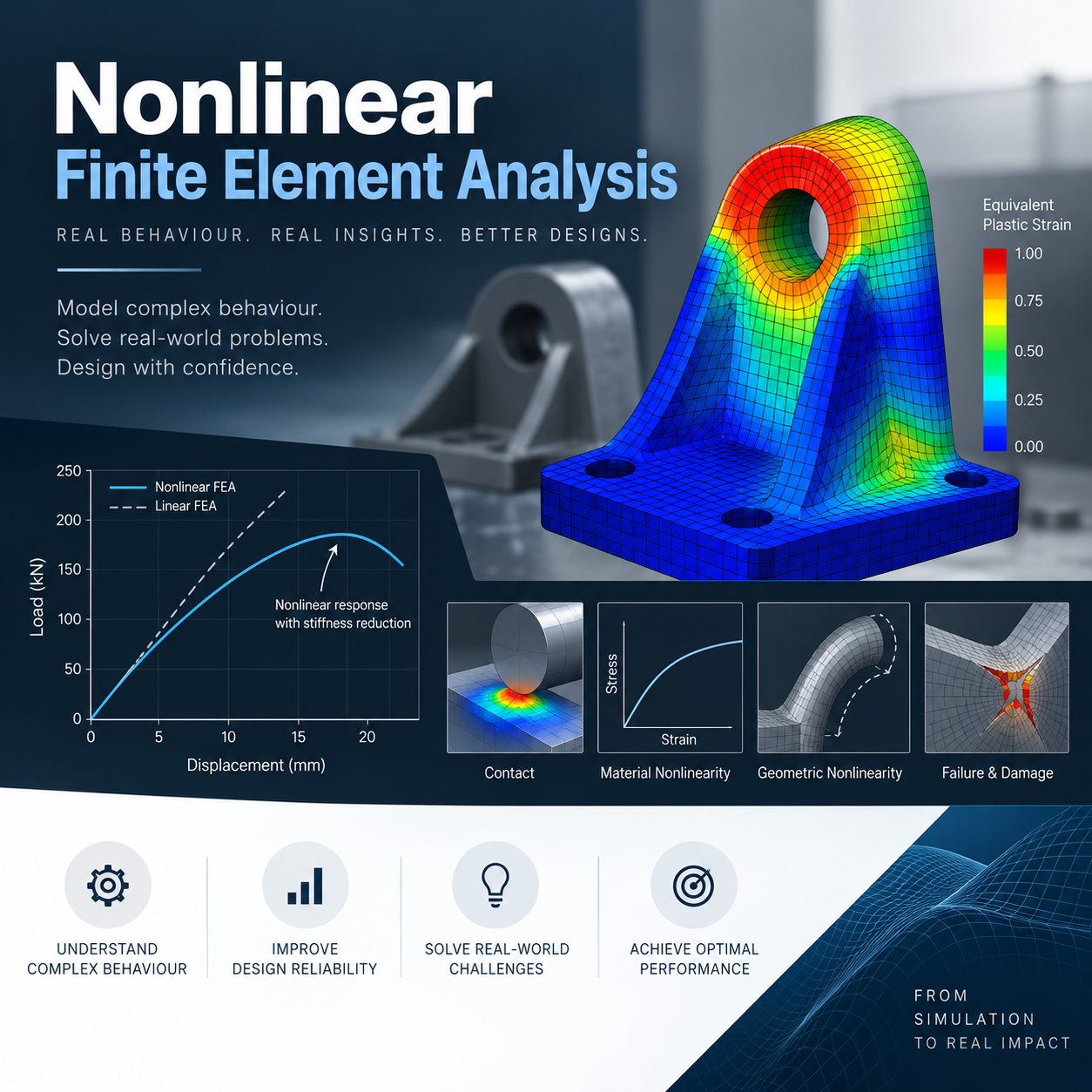
Nonlinear Finite Element Analysis
Move beyond linear assumptions and model the behaviours that dominate real component response.
Study material, geometric, and contact nonlinearities and learn how to set up, solve, and interpret advanced nonlinear FEA models.
Why This Course Matters
Linear FEA is powerful, but many engineering problems involve yielding, large deformation, changing contact, instability, or nonlinear material response. When those effects are significant, a linear model can give incomplete or misleading answers unless the analyst understands nonlinear solution strategy and convergence behaviour.
Modern mechanical design depends on the ability to translate requirements into geometry, calculations, simulation evidence, manufacturing definition, and verification. The strongest engineers understand both the analytical method and the practical consequences of the design choices they make.
This course is designed to close that capability gap with structured, engineering-focused learning that strengthens both technical understanding and professional judgement.
What This Training Helps You Achieve
Study material, geometric, and contact nonlinearities and learn how to set up, solve, and interpret advanced nonlinear FEA models. The training is designed to help you apply this knowledge with greater confidence across design, analysis, verification, manufacturing, and engineering review, while making assumptions, limitations, and technical reasoning easier to explain and defend.
Why Engineers Take This Course
Model behaviour beyond linear assumptions
Develop stronger capability in sources of nonlinearity: material, geometric, and contact, and use that understanding to support more credible decisions in design, analysis, verification, manufacturing, and engineering review.
Manage contact, plasticity, and large deformation
Develop stronger capability in contact definitions, friction, separation, and sliding, and use that understanding to support more credible decisions in design, analysis, verification, manufacturing, and engineering review.
Improve nonlinear convergence and result interpretation
Develop stronger capability in verification, sensitivity studies, and common nonlinear modelling failure modes, and use that understanding to support more credible decisions in design, analysis, verification, manufacturing, and engineering review.
What You’ll Explore
- Sources of nonlinearity: material, geometric, and contact
- Incremental-iterative solution concepts and convergence
- Plasticity models and nonlinear stress-strain behaviour
- Large displacement, large rotation, and geometric stiffness
- Contact definitions, friction, separation, and sliding
- Load stepping, stabilization, tolerances, and solver controls
- Nonlinear boundary conditions and path-dependent response
- Interpreting plastic strain, contact pressure, reaction, and convergence results
- Verification, sensitivity studies, and common nonlinear modelling failure modes
Learning Outcomes
By the end of this course, you will be able to:
- Explain and apply the core principles associated with sources of nonlinearity: material, geometric, and contact.
- Interpret engineering information related to incremental-iterative solution concepts and convergence.
- Evaluate practical considerations involving plasticity models and nonlinear stress-strain behaviour.
- Recognise key assumptions, limitations, and risks associated with contact definitions, friction, separation, and sliding.
- Use structured engineering judgement when working with interpreting plastic strain, contact pressure, reaction, and convergence results.
- Connect analysis and technical evidence with verification, sensitivity studies, and common nonlinear modelling failure modes.
- Approach nonlinear finite element analysis work with greater technical confidence, discipline, and credibility.
Who This Is For
- FEA analysts progressing beyond linear static analysis
- Mechanical and structural engineers working with yielding or contact
- Design engineers assessing high-load or deformation-sensitive components
- Simulation specialists who want stronger nonlinear solution judgement
- Engineers reviewing advanced finite element studies
Why Build This Skill Now
Engineering teams are expected to make faster decisions while still demonstrating sound technical judgement, traceability, and awareness of risk. Building capability in nonlinear finite element analysis gives you a stronger basis for reviewing assumptions, challenging weak conclusions, and contributing more effectively when technical decisions matter.
If you want to strengthen your understanding of this subject, improve the quality of your engineering judgement, and build capability that can be applied across real projects, this course is a strong next step.
Related Topics
nonlinear FEA, nonlinear finite element analysis, material nonlinearity, geometric nonlinearity, contact analysis, plasticity, large deformation, nonlinear structural analysis, finite element method, FEA convergence, nonlinear materials, contact modelling, advanced FEA, structural simulation, FEA solver