
Course Overview
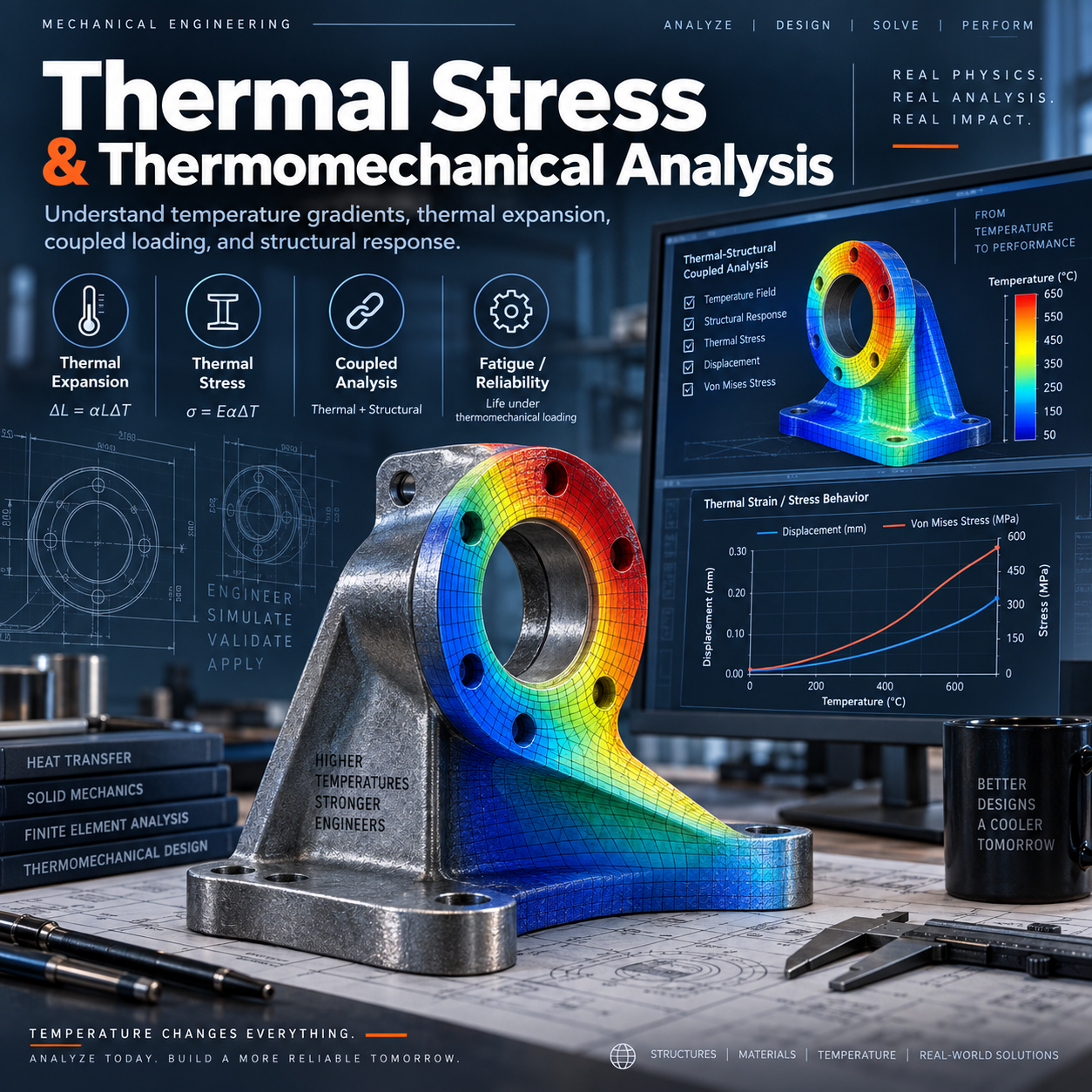
Thermal Stress & Thermomechanical Analysis
Assess how temperature changes become stress, distortion, fatigue, and structural risk.
Analyse thermal expansion, temperature gradients, constraint, thermal cycling, and coupled thermomechanical stresses in engineering components.
Why This Course Matters
Temperature gradients and constrained thermal expansion can generate severe stresses even when mechanical loads are modest. Thermal cycling, material mismatch, local hot spots, and transient conditions can drive distortion, cracking, fatigue, and loss of alignment if thermomechanical behaviour is not properly understood.
Modern mechanical design depends on the ability to translate requirements into geometry, calculations, simulation evidence, manufacturing definition, and verification. The strongest engineers understand both the analytical method and the practical consequences of the design choices they make.
This course is designed to close that capability gap with structured, engineering-focused learning that strengthens both technical understanding and professional judgement.
What This Training Helps You Achieve
Analyse thermal expansion, temperature gradients, constraint, thermal cycling, and coupled thermomechanical stresses in engineering components. The training is designed to help you apply this knowledge with greater confidence across design, analysis, verification, manufacturing, and engineering review, while making assumptions, limitations, and technical reasoning easier to explain and defend.
Why Engineers Take This Course
Translate temperature change into structural response
Develop stronger capability in thermal expansion, thermal strain, and restraint effects, and use that understanding to support more credible decisions in design, analysis, verification, manufacturing, and engineering review.
Assess thermal gradients and restraint effects
Develop stronger capability in temperature-dependent material properties, and use that understanding to support more credible decisions in design, analysis, verification, manufacturing, and engineering review.
Improve thermomechanical modelling decisions
Develop stronger capability in model verification, boundary conditions, and interpretation of thermomechanical results, and use that understanding to support more credible decisions in design, analysis, verification, manufacturing, and engineering review.
What You’ll Explore
- Thermal expansion, thermal strain, and restraint effects
- Steady and transient temperature fields in structural components
- Thermal gradients and resulting stress distributions
- Combined mechanical and thermal loading
- Temperature-dependent material properties
- Differential expansion in assemblies and dissimilar materials
- Thermal cycling and thermal-fatigue mechanisms
- Coupled thermal-structural finite element analysis
- Model verification, boundary conditions, and interpretation of thermomechanical results
Learning Outcomes
By the end of this course, you will be able to:
- Explain and apply the core principles associated with thermal expansion, thermal strain, and restraint effects.
- Interpret engineering information related to steady and transient temperature fields in structural components.
- Evaluate practical considerations involving thermal gradients and resulting stress distributions.
- Recognise key assumptions, limitations, and risks associated with temperature-dependent material properties.
- Use structured engineering judgement when working with coupled thermal-structural finite element analysis.
- Connect analysis and technical evidence with model verification, boundary conditions, and interpretation of thermomechanical results.
- Approach thermal stress & thermomechanical analysis work with greater technical confidence, discipline, and credibility.
Who This Is For
- Mechanical and structural engineers working with temperature-loaded components
- FEA analysts conducting coupled thermal-structural simulations
- Energy, aerospace, automotive, process, and equipment engineers
- Design engineers dealing with thermal expansion and distortion
- Integrity professionals assessing thermal fatigue or high-temperature service
Why Build This Skill Now
Engineering teams are expected to make faster decisions while still demonstrating sound technical judgement, traceability, and awareness of risk. Building capability in thermal stress & thermomechanical analysis gives you a stronger basis for reviewing assumptions, challenging weak conclusions, and contributing more effectively when technical decisions matter.
If you want to strengthen your understanding of this subject, improve the quality of your engineering judgement, and build capability that can be applied across real projects, this course is a strong next step.
Related Topics
thermal stress, thermomechanical analysis, thermal expansion, temperature gradients, thermal strain, thermal cycling, coupled thermal structural analysis, thermal FEA, thermal loading, residual stress, heat transfer stress, mechanical stress, high temperature design, thermal fatigue, structural analysis