

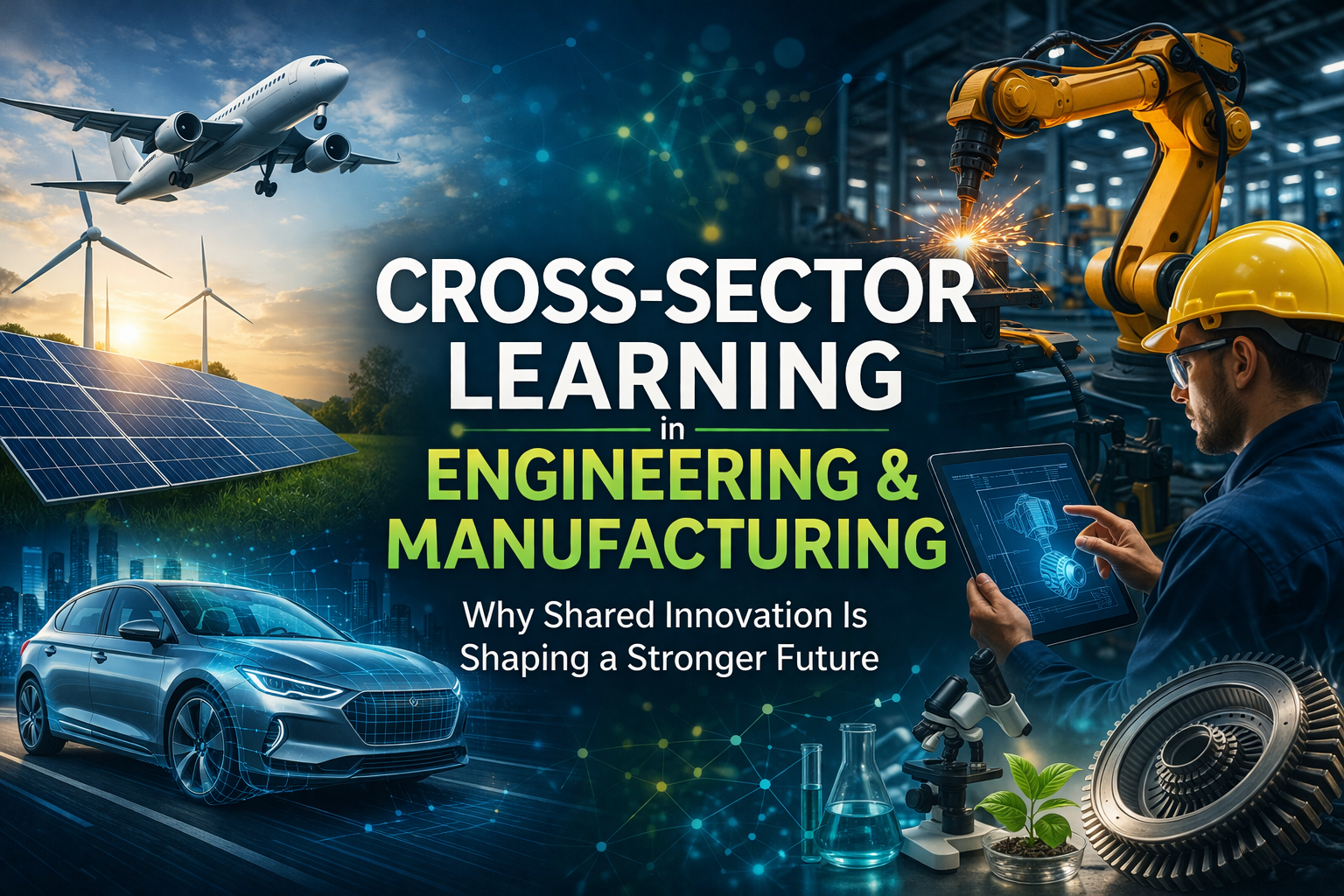
The next leap in engineering may not come from a single breakthrough. It may come from a better habit: learning faster from other industries.
For a long time, the engineering sector behaved like a separate kingdom. Aerospace guarded its precision culture. Automotive mastered speed and scale. Energy is focused on resilience. Life sciences are built around regulation and validation. Civil infrastructure is built over long timelines and under public constraints. That model made sense when technologies moved more slowly. It makes less sense now. Today, the pressures shaping engineering are converging: digitalization, decarbonization, supply-chain risk, ageing workforces, tighter quality expectations and faster product cycles. Cross-sector learning is no longer a nice extra. It is becoming a core operating advantage.
And that shift is one of the most encouraging stories in engineering right now. Even as technology disruption intensifies, the broader labour-market outlook is not purely defensive. The World Economic Forum says technological change, demographic shifts, and the green transition will reshape work by 2030, but it also projects a net increase in jobs overall. The important point is not simply that jobs will change. It is that the engineers and manufacturers best positioned for that future will be those who can transfer methods, tools, and mindsets across sector boundaries.
Engineering is becoming more connected than its org charts suggest
The old silo model is wearing thin because modern engineering problems are increasingly hybrid. Renewable energy projects need power engineering, software, controls, materials, civils and data. Electric vehicles sit at the intersection of mechanical engineering, battery science, electronics, manufacturing systems and cybersecurity. Biomedical engineering now overlaps with automation, advanced materials, sensing and digital modelling. Even traditional infrastructure is becoming more software-defined and carbon-conscious. The work may still be organized by sector, but the knowledge required to do it well is flowing across them.
That is exactly why the conversation about future skills has changed. The UK’s Engineers 2030 work points to growing demand for digital and data capability, sustainability and decarbonization skills, and more coherent pathways into engineering. It also warns that disconnected, sector-specific skills systems are no longer enough and calls for a cross-sector mechanism to track and forecast supply and demand. In parallel, manufacturing workforce research identifies a familiar mix of pressure points: acknowledged skills shortfalls, ageing demographics, fragmented training systems, rapid digitalization, and poor demand alignment across sectors and technologies. Put bluntly, the problem is no longer just a shortage of talent. There is a shortage of connected learning.
The real advantage is not copying. It is translating.
Cross-sector learning is often misunderstood as imitation. In practice, the best version of it looks more like intelligent translation. One sector proves a method under its own constraints; another adapts it to a different environment. Lean does not land the same way in aerospace as it does in automotive. Digital twins do not behave the same way in manufacturing, infrastructure and energy. Additive manufacturing solves different problems in medical devices than in heavy industry. But the underlying disciplines, such as process control, model-based development, traceability, quality assurance and lifecycle thinking, travel remarkably well.
This is also why future-ready engineering talent is increasingly described in terms of breadth plus depth. Manufacturing workforce research argues for more “T-shaped” capability: strong foundational skills combined with deep specialisms that evolve over time. That is a useful description of what cross-sector learning produces. It does not flatten expertise. It makes expertise more portable and more resilient.
Example one: Automotive and aerospace are already sharing the playbook
The exchange between automotive and aerospace is one of the clearest examples of cross-sector learning in action. The automotive industry has long been associated with high-volume production, cost optimization, and relentless process improvement. Aerospace traditionally prioritized lower volumes, extreme tolerances and longer change cycles. But the line between them has blurred. Lean methods such as value-stream thinking and just-in-time principles, once more closely associated with the automotive industry, are now helping aerospace streamline workstations, reduce waste, and improve productivity.
The traffic goes the other way, too. Aerospace-grade quality management, developed under stringent regulatory and reliability requirements, is becoming increasingly relevant to automotive as electrification, advanced driver-assistance systems, and software complexity raise the stakes. The same is true of materials and manufacturing technologies: aerospace has pushed forward composites and additive manufacturing, and those capabilities are increasingly useful to automotive as lightweighting becomes more important in the EV era.
The deeper lesson is that sectors are not just borrowing tools. They are borrowing disciplines of thought: how to industrialize quality, how to cut waste without cutting confidence, and how to move faster in systems that are becoming more complex, regulated and digital. That is where the real leverage lies.
Example two: the green transition is creating a common engineering language
Decarbonization is forcing sectors into shared conversations they once could avoid. Engineers 2030 identifies sustainability and decarbonization as core future skill areas, while the World Economic Forum identifies climate change mitigation, energy generation, storage, and distribution among the most transformative forces for the next five years. In practical terms, that means knowledge of batteries developed in automotive applications is being applied to grid systems and energy storage. Materials innovation in aerospace matters to transport efficiency more broadly. Circular-economy thinking in manufacturing matters to mining, process engineering and product design.
That shift is especially important because it pushes engineering away from narrow optimization and toward systems thinking. The strongest teams increasingly understand not only how a component performs, but also how it affects carbon emissions, repairability, traceability, supply risk, energy use, and end-of-life value. Cross-sector learning helps make that systems view practical rather than theoretical.
Example three: the smartest training models are modular, shared and continuous
If the future of engineering work is more fluid, the future of engineering learning has to be as well. Some of the strongest ideas emerging internationally are not about longer qualification ladders, but about modular, transferable learning built around real technology change. Manufacturing workforce research describes a “skills value chain” that links foresight on future capability needs with role definition, modular curriculum, cooperating providers, and assurance and recognition. Its logic is simple: develop skills in parallel with technology, not years after adoption.
The examples are striking. In Singapore, SkillsFuture pushes future-technology content into approved short courses that can be shared between pre-employment and post-employment learners, with digitalization embedded into existing programmes or offered as modular upskilling units. In Switzerland, industrial digitalization is driving shorter training lifecycles and more “plug and play” learning solutions. In Germany, the pace of Industry 4.0 is putting pressure on technical education to move ahead of industry rather than merely respond after the fact.
This is where the broader workforce picture comes into focus. Recent future-of-work research suggests that skills disruption remains high, with employers expecting 39% of workers’ core skills to change by 2030 and identifying continuous learning as one reason the outlook has stabilized rather than worsened. The message is clear: in engineering, learning cannot be treated as a one-time front-end event. It has to become part of the operating model.
Example four: better training ecosystems can become economic infrastructure
One of the most compelling real-world examples comes from Ireland’s biopharma ecosystem. A dedicated training pipeline built around bioprocessing skills was developed to support high-value industry demand, and manufacturing workforce research links those skills to roughly €10 billion of inward investment into Irish biopharma over a decade. That is an important reminder that skills systems do more than fill vacancies. Done well, they help attract capital, speed adoption, and make regions more competitive.
The same pattern appears elsewhere in different forms. In the US, targeted workforce development has been used to help smaller firms adopt new technologies while also providing training. Learning factories in places such as Chicago, Singapore and Germany are being used to build awareness of industrial digitalization, sensor-rich manufacturing, cybersecurity and simulation-based workflows. These are not abstract education reforms. They are practical mechanisms for shortening the distance between innovation and usable capability.
What this means for engineers in every discipline
For individual engineers, the rise of cross-sector learning is good news. It rewards curiosity, adaptability, and judgment, not just narrow familiarity with a single legacy process. It creates room for mechanical engineers to strengthen their data and control skills, for electrical engineers to understand materials and lifecycle design, for civil engineers to adopt digital-delivery methods from manufacturing, and for manufacturing specialists to influence sectors far beyond the factory floor. That is not a dilution of engineering identity. It is an expansion of engineering usefulness.
It also suggests a better answer to the usual anxiety around automation and AI. The strongest long-term profile is not “know everything” or “specialize forever in one toolchain.” It is “build strong fundamentals, stay technically literate, and keep learning across boundaries.” That is consistent with the evidence from engineering skills planning, industrial workforce research and current employer surveys alike.
The future looks stronger because engineering is learning sideways.
There is still no shortage of difficulty ahead. Skills gaps remain real. Supply chains remain fragile. Technology cycles remain unforgiving. But one thing has improved: sectors are increasingly willing to learn laterally rather than solve every problem alone. Automotive can help aerospace with flow and production discipline. Aerospace can help automotive with quality under constraint. Bioprocessing can show manufacturing what a training ecosystem can do for investment. Digital learning factories can help legacy sectors prepare for Industry 4.0 without waiting for perfect conditions.
That is why the outlook for engineering and manufacturing is stronger than the headlines sometimes suggest. The future will not be built only by invention. It will be built through the transfer of methods, standards, pedagogies, tools, and instincts. The organizations that thrive will be the ones confident enough to learn from outside their lane, disciplined enough to adapt what they borrow, and smart enough to turn shared knowledge into better engineering.