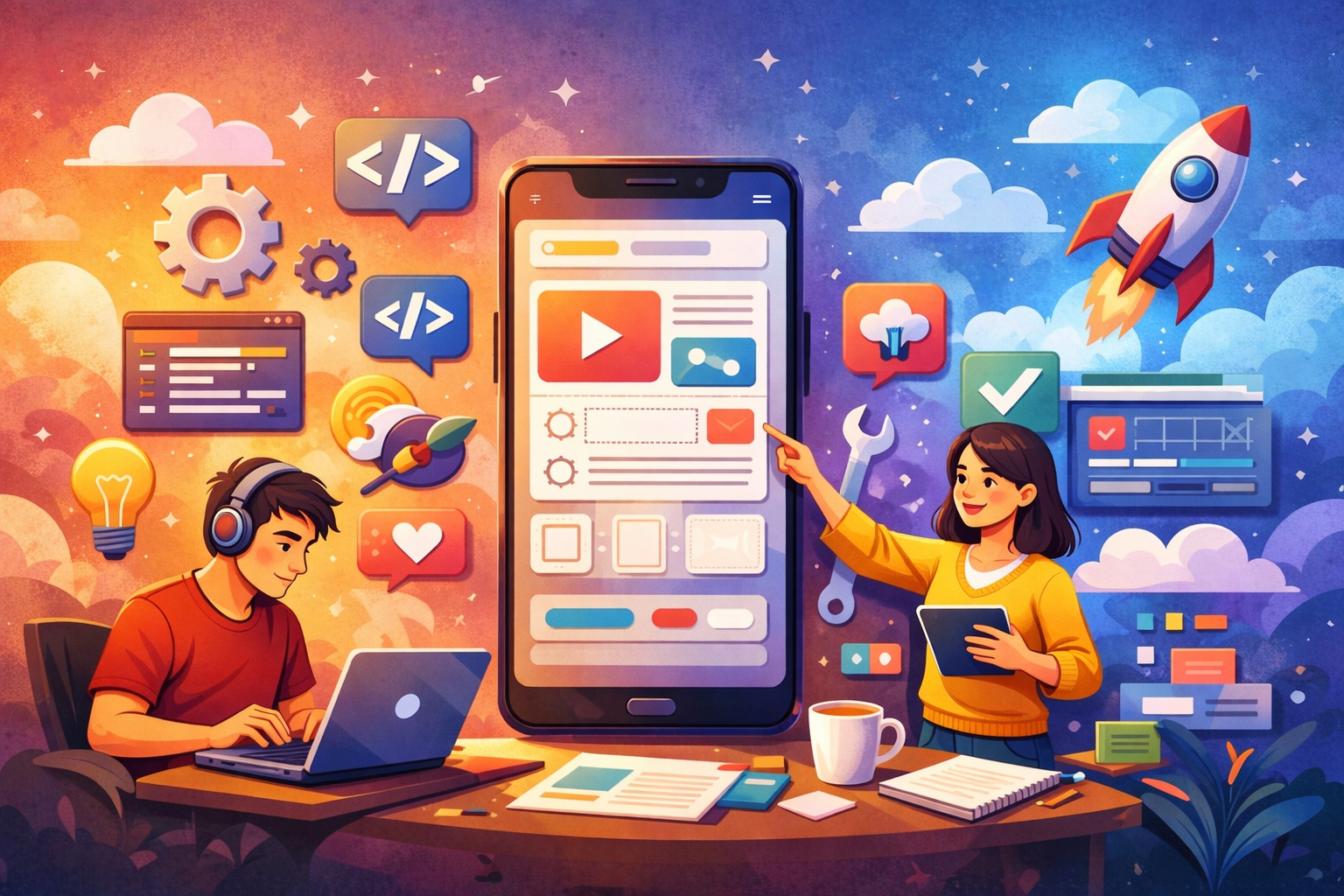
Building an app in 2026 is faster, more flexible, and more competitive than ever. Two major forces are reshaping the process: low-code/no-code platforms (which are increasingly used for enterprise apps) and AI-assisted development (now widely adopted by developers). Together, they compress timelines, reduce cost, and raise user expectations—because users now expect apps to feel polished, personalized, and continuously improving.
This guide walks through a modern, end-to-end approach: from app strategy and tech stack selection to AI-native design, secure building, launch, monetization, and growth.
1) Start With Strategy: Build for Outcomes, Not Features
Before you choose tools or design screens, get clear on why the app exists and what success looks like. In 2026, strong apps are typically tied directly to measurable business outcomes such as increasing customer lifetime value (LTV), reducing churn, improving conversion rate, lowering operational cost, or creating new subscription revenue streams.
A practical strategy step is to define one primary outcome and two secondary outcomes. For example:
- Primary: increase repeat purchases (retention)
- Secondary: increase average order value, reduce customer support workload
Then define KPIs that prove you’re moving the needle—like LTV, cost per acquisition, conversion rate, churn, revenue per user, or time saved per workflow. When metrics are clear, feature decisions become easier: if a feature doesn’t support the outcome, it gets deprioritized.
Also decide early: is this a consumer app, a SaaS product, or an internal tool? The best architecture, monetization, compliance requirements, and UX patterns differ.
2) Identify the Best App Opportunity: Use Cases That Win in 2026
Certain app categories are especially valuable now because they combine clear ROI with strong user demand. Three high-impact directions include:
- eCommerce with personalization engines that tailor product feeds and offers to drive conversion and order value
- SaaS apps with embedded payments + workflow AI, creating strong recurring revenue and automation-driven value
- Internal productivity apps that automate tasks, reduce labor time, and cut operational cost (often the fastest ROI case)
If you’re unsure what to build, look for “high-friction” moments—manual workflows, repetitive support tickets, slow internal approvals, or drop-offs in user journeys. These are usually the most profitable app problems to solve.
3) Plan the Build: MVP First, Then Iterate Fast
The fastest path to success is not “build everything.” It’s:
- Build a focused MVP (minimum viable product)
- Ship it to real users
- Learn from data and feedback
- Iterate in short cycles
Modern low-code and AI-assisted workflows can cut MVP time dramatically, and MVPs can often launch in 2–6 weeks depending on scope.
A good MVP includes:
- One core user journey (the “job to be done”)
- A small set of differentiating features
- Basic analytics and event tracking
- Security and privacy fundamentals (do not postpone these)
Avoid building “nice-to-have” features early. In 2026, speed + learning beats complexity.
4) Choose Your Tech Stack: Match Tools to Risk, Speed, and Scale
Your stack should match your product type, timeline, and long-term needs. In 2026, you typically choose from three layers: cross-platform frameworks, low-code/no-code, and AI-powered development assistants.
Cross-platform frameworks (near-native performance)
These are ideal when you want strong control, scalability, and app-store distribution:
- Flutter for high-performance UIs across mobile/web/desktop
- React Native for fast development with a large library ecosystem
- Kotlin Multiplatform for shared business logic across platforms
Low-code/no-code platforms (speed for MVPs and internal apps)
These shine when time-to-market is critical:
- Bubble for quickly building SaaS web apps and MVPs
- OutSystems for enterprise-grade low-code with governance/testing needs
- Backendless for no-code/serverless backend logic
Low-code tools can reduce development time and costs significantly, but you must still plan carefully for security, maintainability, and integration complexity.
AI-powered development assistants (productivity multiplier)
AI is now a standard advantage for engineering teams:
- GitHub Copilot X for code generation, refactoring, and explanation
- Replit Ghostwriter for prototyping services and integrations quickly
- Framer AI for rapid UI prototypes that can become real responsive pages
Use AI assistants to accelerate implementation, but keep engineering discipline: code review, testing, security scanning, and strong architecture still matter.
5) Design for the AI-Native User: Personalization + Predictive UX
In 2026, users expect apps to be “smart.” They don’t want generic experiences; they want relevance. Two design priorities dominate:
AI-powered personalization
Personalization can significantly boost engagement when it is done gracefully.
Practical examples:
- Personalized product feeds in commerce apps
- Recommendations based on behavior patterns
- Custom “next best action” prompts in productivity tools
The key is subtlety: personalization should feel helpful, not invasive. Offer user controls (like preference settings) so people can adjust what the app personalizes.
Predictive UX
Predictive interfaces anticipate what users need before they search for it—like highlighting likely urgent tasks or generating context-aware suggestions.
Predictive UX works best when:
- Predictions are explainable (“Because you usually do X on Mondays…”)
- Users can easily dismiss or correct suggestions
- The app learns respectfully (without creepy overreach)
6) Accessibility and Compliance: Non-Negotiables Now
Accessibility is no longer optional. Modern apps are expected to follow the latest accessibility guidance (such as ensuring readable text, sufficient contrast, keyboard navigation, and screen reader support).
Compliance also matters more because apps operate globally:
- Privacy requirements like GDPR and CCPA
- Emerging AI regulations and responsible AI expectations
- Industry standards (especially in finance, health, education, and government)
A strong rule: design privacy and accessibility into your foundation, not as a last-minute patch.
7) Build, Automate, Secure: Ship Fast Without Becoming Fragile
CI/CD and deployment best practices
Modern teams ship continuously, with guardrails:
- Keep releases reversible (rollback-ready)
- Use feature flags and canary releases to reduce rollout risk
- Use Infrastructure as Code for consistent environments
- Integrate automated vulnerability scans and secret detection early
This approach supports rapid iteration without breaking production repeatedly.
Zero-trust security mindset
Security must be designed in from day one. A common modern approach is Zero Trust, which assumes no request is trustworthy by default—everything is verified.
Practical security foundations include:
- Strong authentication (often OAuth2, biometric support where appropriate)
- Encryption for sensitive data
- Secure API design and rate limiting
- Logging, monitoring, and incident response readiness
Low-code apps especially must not treat security as “handled by the platform.” You still need proper access control, data handling rules, and secure integrations.
8) Testing in 2026: Use AI to Raise Quality, Not Just Speed
Quality assurance is evolving quickly with AI-driven testing tools:
- AI-assisted UI test generation and maintenance (reducing brittle tests)
- Tools that suggest test cases and identify likely regression risk
- Visual regression testing (screenshot comparisons)
Even with automation, keep one principle: test from the user’s perspective. Early testing prevents expensive fixes and protects retention.
9) Launch, Scale, Monetize: Treat Launch as the Beginning
App Store Optimization (ASO)
If you’re launching on app stores, your listing is a growth engine. In crowded markets, continuous ASO matters:
- Iterate on keywords and metadata
- Test screenshots and preview videos
- A/B test variations to improve conversion
Monetization models that fit 2026 behavior
Common high-performing models include:
- Hybrid pricing (free + subscription + in-app purchases + ads)
- Personalized paywalls triggered by user behavior (carefully and ethically)
- Usage-based pricing for B2B tools (aligning cost to value)
- Microtransactions and modular add-ons to lower entry barriers
Your monetization should match user value. If your app saves time or increases revenue, pricing should reflect outcomes—not just features.
10) Analytics and Growth Loops: Build a Learning Machine
The strongest apps treat product analytics as core infrastructure:
- Track funnels, retention cohorts, feature usage, drop-offs
- Use predictive analytics to identify churn risk and trigger re-engagement
In practice, this means designing “growth loops,” such as:
- A habit loop: notifications or weekly summaries that pull users back
- A value loop: new insights or recommendations that improve with usage
- A referral loop: user-to-user sharing that feels natural and beneficial
Growth loops are how apps scale without relying only on paid ads.
11) Timelines and Costs: What to Expect
In 2026, AI-assisted coding and low-code platforms can reduce both timeline and cost significantly. MVPs can often be delivered in 2–6 weeks, and budgets may be reduced by 30–50% depending on scope and approach.
However, cost depends heavily on:
- Number of user roles and permissions
- Integrations (payments, CRM, ERP, external APIs)
- AI features and inference costs
- Security/compliance requirements
- Scalability needs and performance constraints
A realistic planning approach is to separate cost into:
- MVP build cost
- Ongoing cloud + AI cost
- Maintenance + iteration budget
- Growth and marketing budget
12) A Simple Checklist: From Idea to App
Strategy
- Define the app’s primary business outcome and KPIs
- Identify target users and the core “job to be done”
- Validate demand with quick research and a prototype
Build plan
- Define MVP scope and success criteria
- Choose stack: cross-platform vs low-code vs hybrid
- Plan security, privacy, and accessibility from day one
Execution
- Set up CI/CD, feature flags, monitoring
- Build with iterative releases
- Use AI-driven testing + human validation
Launch and growth
- Implement analytics and retention tracking
- Optimize app store listing and onboarding
- Improve continuously using data and feedback
Conclusion: The 2026 App Playbook
The winning approach in 2026 is clear: build faster using low-code and AI, design for personalized AI-native experiences, ship with strong security and automation, and grow through analytics-driven iteration. When you treat your app as a living product—measured, improved, and refined in cycles—you give it the best chance to stand out in a crowded market and deliver real value over time.